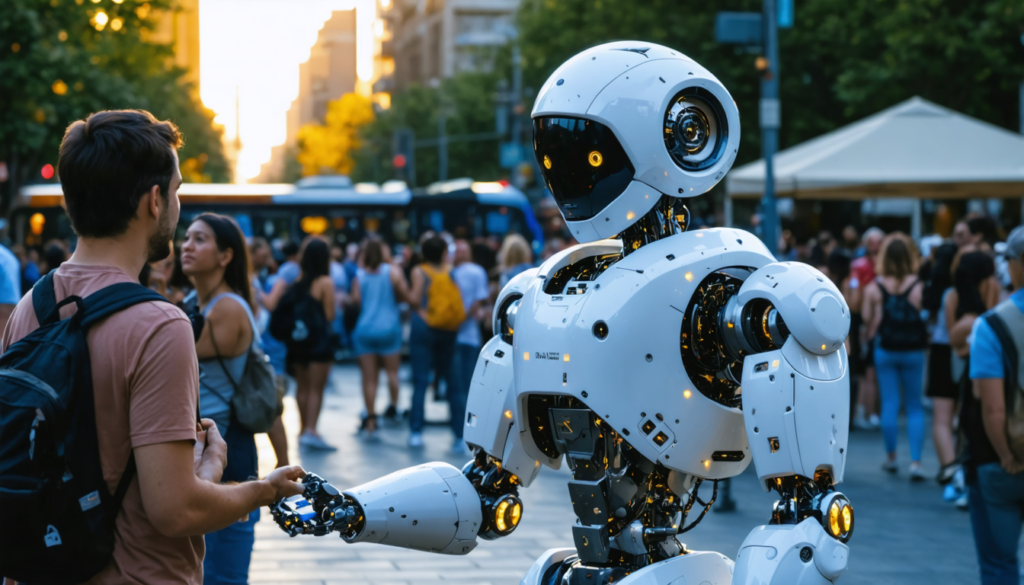
The Tesla Optimus robot reaches a new major milestone in the field of humanoid robotics by achieving a running fluidity close to that of a human. This feat results from a series of technological refinements and continuous improvements in the motor skills and balance of this innovative automaton. The recent publication of a video on the X platform revealed for the first time Optimus running smoothly and naturally, sparking great interest in the world of artificial intelligence and advanced technologies.
Since its launch, Tesla’s Optimus project has established itself as a benchmark in the evolution of autonomous robots capable of performing complex movements. This latest achievement demonstrates not only the mechanical stability of the robot but also the optimization of its control algorithms and its ability to adjust its dynamic supports in real time. Development continues, with ambitious goals that go beyond mere mobility to integrate industrialization functions and human assistance.
- 1 The technical advances enabling the Tesla Optimus robot to run smoothly
- 2 A chronological progression: from the first hesitant step to smooth running
- 3 The role of artificial intelligence in the fluidity of Optimus’s movements
- 4 The industrial and commercial potential of the Tesla Optimus robot thanks to its advanced mobility
- 5 The cultural and societal impact of the arrival of a humanoid robot with human-like movements
- 6 Comparative evolution: Tesla Optimus versus other humanoid robots in modern robotics
- 7 Technical and ethical challenges remaining for a humanoid robot running like a human
- 8 Future perspectives: towards an ever more autonomous and versatile Tesla Optimus robot
The technical advances enabling the Tesla Optimus robot to run smoothly
The dynamic behavior of the Tesla Optimus robot during its smooth runs stems from several key improvements in its physical and software design. Optimus, which measures 1.80 meters and weighs 72.5 kilograms, now has more than 40 degrees of freedom, with an articulated structure allowing more natural movements, notably in the hands which have 11 degrees of freedom, facilitating gripping and manipulating objects with high precision.
This large range of motion is also accompanied by a sophisticated balance framework. The robot is equipped with advanced sensors and a high-performance artificial intelligence system that continuously analyzes posture, anticipates imbalances, and adjusts movements in real time. This responsiveness is essential to achieving fluid running, since walking and running require complex coordination of the lower and upper limbs to maintain stability and ensure propulsion.
The importance of algorithms in dynamic robotics
The progress observed in Optimus’s running fluidity is largely explained by advances in motion control algorithms. Tesla has implemented machine learning systems that allow the robot to learn from its own experiences. Through this process, Optimus can optimize its trajectories, adapt the force exerted on its footfalls, and anticipate the effect of different speeds and step amplitudes.
The robot benefits from a data corpus derived from previous tests and virtual simulations, which allows refining the management of each joint in a personalized way. The goal is to achieve a perfect balance between energy efficiency and mechanical stability, a challenge that many humanoid robots are still struggling to meet.
Hardware innovations serving performance
On the hardware side, the embedded 2.3 kWh battery provides remarkable autonomy for a robot of this size, with energy consumption ranging from 100 watts at rest to about 500 watts at full activity. Tesla has designed a lightweight and robust frame capable of absorbing shocks and resisting wear without sacrificing joint flexibility.
- High-capacity battery (2.3 kWh) offering endurance and power
- More than 40 degrees of freedom for natural movement
- Integrated pressure sensors and gyroscopes for dynamic balance
- Lightweight composite materials to improve agility
- Machine learning algorithms for continuous adaptation
| Characteristic | Description | Running-related advantage |
|---|---|---|
| Degrees of freedom | More than 40 movable joints including 11 for the hands | Precision and fluidity of gestures |
| Battery | 2.3 kWh, light and durable | Extended autonomy, consistent available power |
| Sensor systems | Pressure, accelerometers, and gyroscopes | Maintains balance and adapts in real time |
| AI software | Motion learning algorithms | Continuous movement optimization |

A chronological progression: from the first hesitant step to smooth running
The emergence of the humanoid robot capable of running requires close observation of the different stages Tesla has crossed in this ambitious project. As early as 2023, Optimus demonstrated its first abilities to hold complex postures such as those practiced in yoga, signaling a nascent mastery of static balance.
Throughout 2024 and during 2025, this ability gradually evolved to include faster and more precise movements. Handling light objects and performing simple assembly tasks showed increased coordination between sensory perception and motor action. Although the early versions of the robot were not without hesitations, Optimus is now capable of chaining complex and dynamic sequences, demonstrating a calm adaptation to its environment.
- 2023: static postures and first trials of robotic yoga
- Early 2024: handling light objects and pick-and-place
- Mid-2025: execution of simple assembly sequences
- September 2025: demonstrations of slow movements and basic coordination
- October 2025: first smooth kung-fu movements accompanied by a professional
- December 2025: spectacular demonstration of fluid running
| Year | Stage | Result achieved |
|---|---|---|
| 2023 | Yoga and static balance | Robot capable of holding complex positions |
| 2024-2025 | Handling and assembly of objects | Improved hand-eye coordination |
| End of 2025 | Dynamic movements and running | Running fluidity close to that of a human |
This rapid evolution positions Tesla as a major and promising player in the field of humanoid robotics, capable of responding to varied needs ranging from industrial production to personal assistance.
The role of artificial intelligence in the fluidity of Optimus’s movements
Artificial intelligence is at the heart of Tesla Optimus’s ability to reproduce human movement cycles with astonishing fluidity. One of the essential challenges in robotics is achieving fine coordination between sensory perception and motor output. In Optimus’s case, deep neural networks assist the management of numerous joints and allow modulation of physical effort according to external constraints.
This advanced AI works with several interconnected modules:
- Environmental perception: visual and proprioceptive analysis to anticipate trajectory
- Motor control: dynamic adjustment of each joint in real time
- Balance and dynamics: management of forces and counterforces to avoid falls
- Adaptive learning: continuous improvement from feedback
Thanks to this modular structure, Optimus can react quickly to obstacles or terrain changes, adjusting its steps within milliseconds. This plasticity in motor control is crucial to developing fluid running where each movement flows seamlessly, realistically reproducing human gait.
| AI Module | Description | Impact on fluid running |
|---|---|---|
| Environmental perception | Cameras and sensors for instant mapping | Prevents obstacles and adapts trajectory |
| Motor control | Coordination of 40+ joints | Optimization of running phases |
| Balance management | Motion sensors and gyroscopes | Maintains dynamic stability |
| Adaptive learning | Experience-based machine learning | Constantly improves fluidity |

The industrial and commercial potential of the Tesla Optimus robot thanks to its advanced mobility
The ability to run smoothly opens unprecedented prospects for the industrial and commercial use of Optimus. Tesla aims to produce and deploy up to 5,000 Optimus units by the end of the year, thanks to an innovative production line the company presents as capable of “self-replication,” meaning robots helping build other robots.
Advanced mobility allows Optimus to adapt to various work environments:
- Logistics: efficient movement in warehouses and distribution centers
- Industrial assembly: transport of parts and intervention on production lines
- Services: personal assistance in domestic or public spaces
- Security: dynamic patrols and rapid intervention in case of incidents
| Application | Advantage of fluid mobility | Concrete example |
|---|---|---|
| Logistics | Fast and maneuverable movement without jolts | Automatic transport of parcels in warehouse |
| Assembly | Precision and speed of interventions | Assembly of electronic components |
| Services | Natural interaction with humans | Assistance in hospitals or care homes |
| Security | Increased responsiveness | Surveillance of sensitive areas |
The estimated price of Optimus ranges between 20,000 and 30,000 dollars, which could open an accessible consumer and professional market. This marks a major turning point where robotic technology meets significant economic and social imperatives.
The cultural and societal impact of the arrival of a humanoid robot with human-like movements
The release of a video showing the Tesla Optimus robot running with such fluidity also raises cultural and social questions. This level of humanization in movements helps bring robotics closer to the domains of art, sport, and even psychology. Optimus’s ease in reproducing typical human movements nurtures reflection on coexistence and human-machine collaboration.
Society faces several challenges:
- Social acceptance: familiarization with robots capable of human gestures
- Ethics: limits of autonomy and responsibility in case of error
- Labor market: rapid transformation of jobs and creation of new tasks
- Human interaction: new modes of communication and assistance
| Challenge | Issue | Example |
|---|---|---|
| Social acceptance | Avoid distrust through familiar appearance and movements | Robots welcoming visitors in shopping centers |
| Ethics | Define usage rules and limits of autonomous decision-making | Protocols in hospital environments |
| Employment | Retraining and education in robotics | Training operators to manage robots |
| Human interaction | Develop natural and intuitive interactions | Assistant robots in households |
This stage marks the beginning of a new era where humanoid robotics could become an everyday element of human life, changing how we interact with technology and work.

Comparative evolution: Tesla Optimus versus other humanoid robots in modern robotics
In the landscape of modern robotics, Tesla Optimus is not alone in advancing towards achieving fluid human-like movements. Figure, another recognized company, recently showcased its own humanoid robot capable of natural running, rivaling Optimus’s performance. The comparison between these technologies highlights distinct approaches and common sector challenges:
- Tesla Optimus: relies on mass production and a high budget to refine AI and mobility
- Figure: focuses on development speed and specific industrial applications
- Other competitors: Boston Dynamics, Honda, etc. Focus on robustness and versatility
| Company | Main characteristic | Technological strength | Current limitation |
|---|---|---|---|
| Tesla Optimus | Mass production and advanced AI | Fluidity and coordination in running | Development still ongoing |
| Figure | Speed of development | Natural and fast running | Lack of consumer applications |
| Boston Dynamics | Robustness and varied mobility | Balance on complex terrains | High cost |
These innovations show that humanoid robotics is entering a crucial phase where fluidity and movement dynamics become major differentiation criteria.
Technical and ethical challenges remaining for a humanoid robot running like a human
Despite spectacular progress, several technical and ethical challenges remain for Tesla Optimus to become a fully reliable robot in daily life. On the technical side, durability of components, long-term energy management, and safety of artificial intelligence in unforeseen situations need to be improved.
On the ethical level, human control remains paramount. Ensuring that all critical decisions and dangerous actions remain under human supervision is a priority to avoid unexpected incidents. Moreover, it is essential to minimize biases in algorithms so that the robot does not adopt discriminatory or inappropriate behaviors.
- Improvement of physical durability and shock resistance
- Optimization of energy consumption and autonomy
- AI algorithm safety and human supervision
- Management of risks of errors and malfunctions
- Strict ethical framework to prevent abuses
| Challenge | Possible solutions | Importance |
|---|---|---|
| Mechanical durability | Use of reinforced composite materials | High |
| Energy endurance | Development of new high-capacity batteries | High |
| AI safety | Mandatory human supervision and rigorous testing | Critical |
| Ethics | Creation of charters and control protocols | Very important |
Caution is necessary in large-scale deployment to preserve trust and safety during this robotic revolution.
Future perspectives: towards an ever more autonomous and versatile Tesla Optimus robot
Looking to the future, expected evolutions for Tesla Optimus include increasing energy autonomy, better contextual intelligence, and greater versatility within domestic, professional, and industrial environments. Elon Musk speaks of a “self-replicating production line” where robots themselves would participate in their construction, making production more agile and scalable.
Within this framework, Optimus could become a key player for:
- Repetitive or dangerous manual work in industry
- Assistance to people with reduced mobility in daily life
- Participation in rescue missions in difficult terrain
- Performing complex tasks requiring precision and adaptability
| Future objective | Expected benefit | Example of application |
|---|---|---|
| Increased energy autonomy | Long durations without recharging | Continuous work in factory or rescue |
| Improved contextual intelligence | Reactions adapted to environment | Natural interactions with humans |
| Versatility of use | Multi-tasking capability | Domestic and industrial assistance |
Tomorrow’s robotics could therefore largely rely on hybrid systems where technological mastery and understanding of human interactions are inseparable.