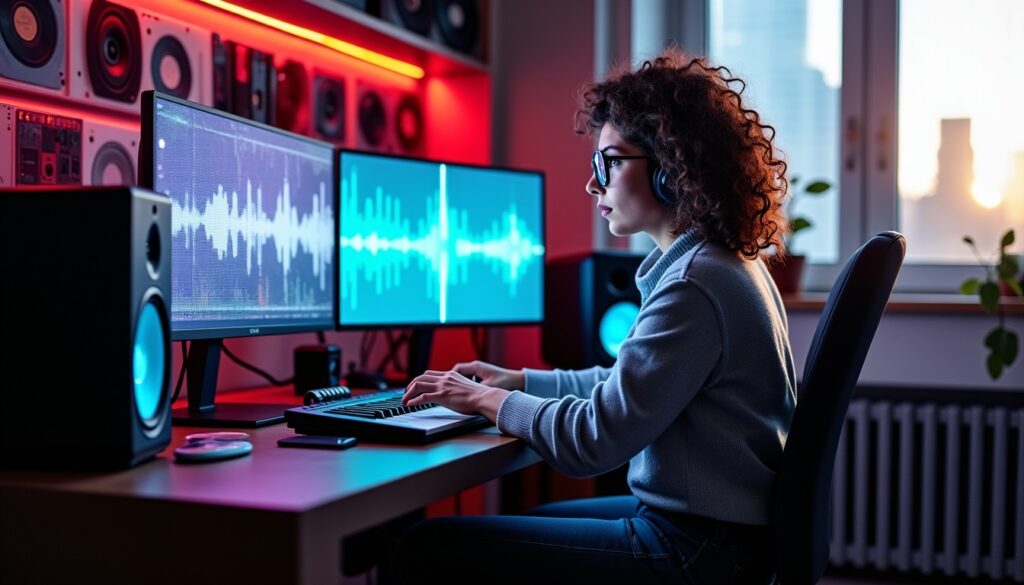
In a world where creativity meets technology, Google has opened a new era with Lyria, its artificial intelligence model dedicated to AI-assisted music. The year 2026 marks a monumental milestone in the evolution of this musical technology, thanks to a series of innovations that push the boundaries of automatic composition. Google Lyria is no longer just a simple loop generator; it becomes a true ally for artists and creators, capable of designing complete and coherent tracks lasting up to three minutes. This technical advance, relying on sophisticated generative models and machine learning, establishes a new paradigm in digital music creation, where every user, even those without technical skills, can shape their own musical works with a quality close to that of a professional composer.
The stakes of this innovation are all the more crucial as they occur in a fierce competitive context where other platforms try to hinder the distribution of AI-generated content. Google, on the other hand, chooses to democratize AI-assisted music on an international scale, offering creations in multiple languages and integrating its tool into its professional ecosystem. This strategy is based on an ambitious vision: to make Lyria 3 Pro not only a model of excellence in automatic music production but also a powerful lever for businesses and professionals seeking to unleash their creativity while optimizing their production costs.
- 1 The major innovations of Google Lyria Pro in music generation
- 2 Vocal creation and lyrics: Lyria’s advances in AI singing
- 3 Automatically generated album covers via Nano Banana
- 4 Lyria’s integration into Google Vids’ professional ecosystem
- 5 Lyria 3 Pro facing industrial and legal challenges of AI-generated music
- 6 The impacts of Google Lyria on musical and professional creation
- 7 Comparative table of features between basic Lyria and Lyria 3 Pro
- 8 What benefits for users and professionals with Google Lyria?
- 9 Evolution perspectives and technical challenges for Google’s AI music
The major innovations of Google Lyria Pro in music generation
The launch of Lyria 3 Pro represents a true revolution in the field of music generated by artificial intelligence. Until now, Lyria users had musical pieces limited to about 30 seconds, often created in the form of repetitive loops. This constraint greatly limited the creative potential, confining compositions to short and sometimes unnatural formats.
With Lyria 3 Pro, Google takes a significant step by offering an extension of tracks’ duration up to three minutes. This increased capacity is not just a simple temporal extension: the produced music now features a well-defined structure, including classic elements such as intro, verses, choruses, and bridges. This technological advance illustrates the enhanced sophistication of generative models, capable of reproducing the complex musical architectures characteristic of contemporary hits.
This automated musical structuring relies on machine learning algorithms that analyze and synthesize relevant sound patterns optimized for overall coherence. The result is an engaging product, far from the boring repetitions of the first generations of musical AIs. This opens the way for more expressive and nuanced creations, adapted to a wide variety of styles and genres. For example, a user can easily compose a melodious ballad with harmonic subtleties or a rhythmic electro track with dynamic transitions.
The development also pays particular attention to accessibility, making the tool intuitive for everyone, even without musical training. In this way, beginners can quickly immerse themselves in the creative process, exploring different musical atmospheres in just a few clicks. Google has thus designed Lyria 3 Pro as a natural extension of its ambition to democratize musical technology and make automatic composition accessible to a broader audience.
Vocal creation and lyrics: Lyria’s advances in AI singing
One of the most remarkable features of Google Lyria lies in its ability to generate sung voices and quality lyrics, enhancing the AI-assisted music creation experience. While some previous generations of AI struggled to produce coherent texts or natural voices, Lyria Pro benefits from a notable evolution in vocal integration.
The combination of advanced speech synthesis and automated text generation enables the platform to offer complete songs with adapted lyrics in several languages including French, English, Spanish, German, and others. This linguistic diversity is essential to cater to a global audience and create a personalized experience according to local cultures and musical sensitivities.
However, although the generated lyrics represent significant progress, they sometimes remain imperfect in terms of narrative coherence or poetic depth. The system often prioritizes phonetic fluidity and rhythm over thematic complexity. Nevertheless, this aspect does not hinder practical use: the speech synthesis produces a natural rendering that blends harmoniously with the arrangements and contributes to the feeling of a finished track.
Concrete examples show that independent artists or content creators can thus compose a title with tailor-made voice and lyrics, facilitating the production of soundtracks for videos, games, or multimedia projects without having to hire a singer or a songwriter. Lyria Pro’s flexibility also makes text editing easier, as users can adjust the lyrics according to their artistic preferences, opening creation to an innovative human-machine collaboration.
Automatically generated album covers via Nano Banana
The visual dimension accompanies the musical revolution of Google Lyria. Through its Nano Banana system, the company integrates an automatic album cover generator, ensuring aesthetic coherence for sound creations. This addition represents a strategic step in the multimedia production chain, where every musical creation is enhanced by an attractive and style-appropriate visual.
The Nano Banana generator uses artificial intelligence techniques capable of interpreting the emotions, style, and mood of the tracks to offer original album covers. For example, a soft jazz track will produce a cover with warm and refined tones, while a dynamic electro composition will receive a more futuristic and vibrant illustration.
Thanks to this integration, users benefit from a complete creative kit in a single tool. This is particularly relevant for independents or small structures without dedicated graphic design teams. The automated aspect also avoids costs associated with traditional visual production while ensuring a professional quality rendering.
This complete function, combined with musical and vocal generation, makes Google Lyria a true virtual studio accessible online. Creators can quickly experiment with different visual styles, which stimulates innovation and personalization in their artistic projects.
Lyria’s integration into Google Vids’ professional ecosystem
Beyond individual uses, Google Lyria fits into an advanced integration strategy within the Google ecosystem, notably with the Vids application, dedicated to video post-production. This depth of integration illustrates a pragmatic vision aimed at optimizing the creative productivity of companies and organizations.
Vids now allows users to directly incorporate tracks generated via Lyria, adapted to their specific needs, without leaving the platform. This synergy simplifies the workflow, considerably reducing delays and costs related to the search or licensing of external music, a major issue in the professional sector. The tool thus supports marketing teams, audiovisual content creators, as well as agencies in their multimedia production.
This integration strategy reflects a strong ambition: to make Lyria a central component in collaborative creation environments, where music becomes a modular and customizable element according to the project. The paid subscription model, with Business, Enterprise, or Google AI Pro offers, confirms that the company wants to position Lyria as a premium service at the heart of its professional solutions, thus reinforcing the attractiveness of its cloud and AI offerings.
Finally, this approach encourages the rapid spread of innovation within different sectors, integrating the notion of creative automation into the daily lives of businesses, with a reduction in dependence on traditional external resources.
Lyria 3 Pro facing industrial and legal challenges of AI-generated music
The rapid development of musical AI technologies inevitably raises debates around copyright, artistic value, and the role of human composers in the creative chain. Google Lyria, with its remarkable progress, is not immune to these fundamental questions shaking the music industry in 2026.
Traditional industry players, especially record labels and songwriter-composers, sometimes adopt a protective stance regarding the widespread use of automatically generated content. The main fear lies in the market saturation by stock music of variable quality, likely to devalue original creation and impact artists’ revenues.
On their side, streaming platforms face significant tension about the balance between human and synthetic content. Several players try today to limit the integration of AI-generated tracks, while Google bets on democratization and accessibility, notably targeting businesses and independent creators.
This tension reflects a difficult evolution, where musical technology helps push the limits of automatic composition while questioning the very notion of intellectual property in a digital universe. Google takes a strategic position here by offering a segmented offer: a free version for the general public allows discovering the technology, and paid plans aim to conquer the professional market.
This choice embodies a balance between innovation and respect for rights, even if regulatory and ethical discussions remain open and lively in various professional spheres.
The impacts of Google Lyria on musical and professional creation
The arrival of Lyria 3 Pro significantly changes the landscape of musical creation, especially for videographers, content creators, and businesses. The possibility of generating structured tracks adapted to specific projects opens unprecedented opportunities for multimedia production.
Thanks to this evolution, creators now have at their disposal a virtual orchestra instantly accessible, capable of providing a complete soundtrack, with voice, lyrics, and accompaniment. This service drastically reduces dependence on traditional sound libraries while offering high customization. For example, a start-up launching an advertising campaign can create original music in a few minutes, perfectly aligned with its brand image and message.
For professionals, this also means increased efficiency in producing audiovisual content. Deadlines shorten, iterations multiply easily, encouraging experimentation and innovation without significant additional costs. At the same time, this technology transforms professions related to musical composition, forcing a rapid adaptation of traditional skills and roles.
Nevertheless, this technological upheaval should not overshadow certain risks. Composers specialized in institutional or soundtrack music could see their demand decrease in the face of the rise of automated solutions. The rise of Lyria therefore encourages these professionals to reposition themselves in niches valuing human creativity and collaboration with AI.
Comparative table of features between basic Lyria and Lyria 3 Pro
| Features | Lyria (classic version) | Lyria 3 Pro |
|---|---|---|
| Track length | About 30 seconds | Up to 3 minutes |
| Musical structure | Repetitive loops | Intro, verses, choruses, bridges |
| Vocal generation | Limited, robotic voices | Natural voices and multilingual lyrics |
| Album cover creation | Not available | Available via Nano Banana |
| Professional access | Not included | Reserved for paying subscribers (Business, Enterprise, AI Pro) |
| Integration with Vids | Not integrated | Integrated into the Vids environment for post-production |
What benefits for users and professionals with Google Lyria?
- Increased accessibility: allows beginners to easily compose structured tracks.
- Time savings: accelerates music production with almost immediate creations.
- Cost reduction: less need to buy licenses or hire musicians.
- Customization: tailor-made tracks with language and style choices.
- Professional synergy: integration with video creation tools like Vids.
- Visual innovations: automatically generated album covers for a complete rendering.
Evolution perspectives and technical challenges for Google’s AI music
Despite significant progress, AI music still faces several challenges to achieve artistic quality comparable to human composers. Future developments should focus on improving lyrics, strengthening coherence and narrative depth. The emotions expressed in tracks always require subtler work to avoid the risk of mechanical or generic productions.
The technological environment also imposes strong constraints in terms of performance and optimization. Generative models must be capable of quickly generating complex compositions while sparing computational resources. Google is thus working on optimizing its neural networks to offer a balance between sound quality and execution speed.
Moreover, the question of intuitive interaction with the user remains central. The promised simplicity must combine with the necessary flexibility so creators can refine tracks according to their specific tastes. Thus, the next generation of Lyria should offer more dynamic and customizable interfaces, providing greater control over arrangements and sound textures.
Finally, Google continues to invest in ethical research around AI-assisted music, seeking to preserve the recognition of human authors while offering democratic access to creation. This balance remains a major challenge for the entire industry.
What is the main novelty of Google Lyria 3 Pro?
The main innovation lies in the ability to generate complete musical tracks up to three minutes long, with a sophisticated musical structure including intro, verses, choruses, and bridges.
What types of users can access Lyria 3 Pro?
Lyria 3 Pro is mainly intended for paying subscribers, notably Business, Enterprise, Google AI Pro, and Ultra plans, offering advanced functionalities adapted to professional needs.
How does Lyria improve the visual creation associated with music?
Thanks to Nano Banana, Lyria automatically generates album covers matching the styles and moods of the tracks, allowing a professional visual rendering integrated with the musical creation.
Can Lyria replace human composers?
Lyria is a powerful assistant that facilitates music production, but it does not fully replace human composers, especially for creations requiring strong emotional and artistic creativity.
Is music generated by Lyria available in multiple languages?
Yes, Lyria offers generation of tracks with lyrics in French, English, Spanish, German, and several other languages, facilitating international adoption.