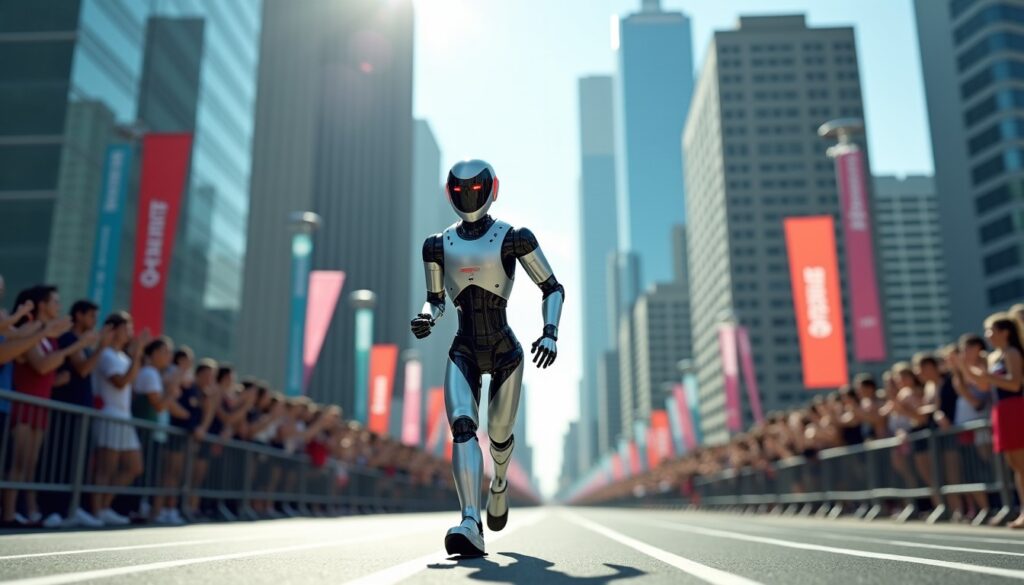
When it was thought that human athletic performances were unbeatable, a new chapter opens thanks to technology and advanced robotics. In Beijing, an event left a mark and redefined the limits of what is possible in the field of athletics: a Chinese humanoid robot shattered the human world record for the half marathon. This is not simply a victory against the clock, but a true conceptual revolution that demonstrates how technology can now compete with, or even surpass, the feats of the best human athletes. Facing thousands of runners, two machines distinguished themselves with an impressive performance, testimony to the rapid progress made by China in the field of sports robots.
This half marathon, organized in the heart of the Chinese capital, highlighted a key player: Honor, the Chinese smartphone specialist brand, which has decided to invest in designing robots with athletic capabilities. The robot nicknamed “Lightning”, designed by Honor, completed the distance in 50 minutes and 26 seconds, thus beating by nearly seven minutes the previous human record held by Ugandan runner Jacob Kiplimo. How did a machine, without breath or fatigue, achieve this? With what technologies and strategies did this robot surpass human bodies trained and prepared for years?
This performance is no accident. The design, mechanics, onboard artificial intelligence, all contribute to a fluidity and efficiency that leave one speechless. Robots are no longer mere isolated prototypes: they become full-fledged competitors capable of executing, analyzing, and adapting their run in real time. This half marathon not only sets a record but above all opens the door to a new era where humans and robots compete or cooperate in disciplines previously reserved for athletes.
- 1 The technical features of the Lightning robot that revolutionized the half marathon
- 2 An impressive race: the strategy and preparation behind the robot’s performance
- 3 The impact of sports robots on the future of athletics and competitions
- 4 Major advances in artificial intelligence in sports robotics
- 5 Reactions from the athletics world to this robot-shattered record
- 6 Economic and industrial implications of the robotic half marathon in China
- 7 Ethical and societal challenges posed by athlete robots
- 8 Upcoming innovations and evolution perspectives of Chinese sports robots
The technical features of the Lightning robot that revolutionized the half marathon
To understand the feat of this Chinese robot, it is essential to dive into its technical features and the design conceived by its engineers. Lightning is equipped with legs nearly 95 centimeters tall, specially designed to replicate the long and powerful stride of the best runners. This convincing biomimicry allows the robot to run with remarkable efficiency, bringing its speed closer to that of elite athletes.
But mechanics alone are not enough. The integration of sophisticated artificial intelligence plays a major role. It allows the robot to analyze the terrain in real time, adjust its trajectory, and adapt its speed according to the pace of other participants and the constraints of the course. It is reactive intelligence, going beyond simple preprogrammed control, making the robot an autonomous competitor capable of making instant decisions during the race.
Beyond the legs and the AI, the energy aspect must not be overlooked. The management of the robot’s battery and weight are optimized to maximize endurance. The structure uses ultra-light and resistant materials, ensuring that Lightning can run the half marathon without losing speed or stability, even on more difficult sections or in case of external disturbances, such as a fall or an unexpected obstacle.
| Features | Description | Key Advantage |
|---|---|---|
| Leg height | 95 cm, biomimetic stride | Stride length and efficiency, optimal speed |
| Artificial intelligence | Real-time analysis, autonomous adjustment | Rapid decision-making and adaptation during the race |
| Materials | Lightweight reinforced composite | Increased endurance and stability |
| Energy system | Optimized high-capacity battery | Long-distance autonomy without slowdown |
This technological cocktail confirms that Lightning, far from being a simple machine, is a true robotic athlete, designed to excel in extreme and demanding conditions like those of a half marathon. Its performance demonstrates how perfectly China masters the integration of robotics and artificial intelligence to transform abstract concepts into tangible results.
An impressive race: the strategy and preparation behind the robot’s performance
This victory was not improvised. Honor’s engineers deployed considerable efforts in the strategic preparation of their “Lightning” robots and its two companions, all lined up at the starting line. The participation of three robots illustrates the much broader ambition to transform these machines into credible actors of endurance sports.
The preparation was based on intense simulations. Each segment of the course was studied, mapped, and analyzed, allowing anticipation of difficulties such as sharp turns or changes in surface. This data was used to adjust the robot’s autonomous driving algorithms, offering better effort management and optimization of trajectories.
Another key point is the repetition of full-scale tests. Honor increased the number of participating robots from about twenty to more than a hundred this year, demonstrating significant progress in reliability and robustness. This test group allowed refinement of race behaviors, observation of interactions between multiple robots (collisions, overtaking), and improvement in the management of unforeseen events.
Each robot is equipped with an advanced sensor system capable of observing its environment and detecting obstacles and competitors. This capability facilitates adaptation to all hazards of the course, a true technical turning point in sports robotics. For example, during the race, delicate situations such as group slowdowns or potential collisions are handled by quick and autonomous adjustments, avoiding stops or loss of balance.
It is not just a matter of raw speed but also tactical intelligence: knowing when to accelerate, when to hold back, how to maintain the best rhythm until the end. This dose of strategy makes Lightning’s victory even more impressive, comparable to the qualities of an experienced human athlete.
The impact of sports robots on the future of athletics and competitions
The performance of the Chinese robot Lightning prompts reflection on the future of sport and endurance competitions. The arrival of sports robots raises a double question: their integration into traditional competitions and the evolution of public expectations around these new competitors.
The achievements attained surpass human capabilities, arousing both fascination and questioning. Can we envision mixed competitions where humans and robots truly compete? Or should distinct categories be created? The debate is open. Technology radically changes the very nature of what a sporting race is.
On one hand, sports robots enable pushing measurable physical limits, bringing an innovative show and records unattainable by humans. On the other hand, human physical fragility finds a new contrast against tireless machines. The presence of robots pushes coaches and athletes to rethink their training methods, perhaps towards forms of cooperation with technology.
This revolution also inspires scientific research in biomechanics and sports physiology. Cross-studies between robots and human performances could lead to innovations beneficial for both worlds. For example, analyzing strides or strategies developed in machines may feed progress in sports training and recovery.
While waiting to witness true races opposing robots and humans, the trend shows that technology is now an unavoidable player. It shapes the future of athletics, proposing a new paradigm where performance goes beyond the organic condition.
Major advances in artificial intelligence in sports robotics
One of the keys to Lightning’s success lies in the advanced integration of artificial intelligence capable of managing the complexity of a long-distance race. Unlike early prototypes or remote-controlled robots, this generation relies on an AI in continuous learning.
Robots are equipped with sophisticated sensors: lidars, cameras, gyroscopes, and accelerometers. These devices provide them with a considerable amount of information to analyze in real time. By combining this data with machine learning algorithms, the robot adjusts its posture, energy, and pace instantly.
A remarkable aspect is the robots’ ability to anticipate future situations based on their current environment. For example, during a turn or approaching an obstacle, the AI prepares the trajectory to follow by analyzing not only immediate data but also the dynamics of the group and possible weather variations. This advanced reactivity results in a smooth, jerk-free race.
Autonomy is a fundamental element. Nearly half of the robots crossed the finish line without any direct human assistance, proving the maturity of the embedded technologies. This shows a real ability to operate in an “open world”, amid real and unpredictable conditions, far from a simple laboratory scenario.
- Real-time data collection and analysis thanks to multispectral sensors.
- Machine learning to optimize stride and race strategy.
- Obstacle anticipation and instant pace adaptation.
- Internal communication between robots to avoid collisions and enhance group efficiency.
- Energy autonomy for optimal battery management.
These innovations demonstrate that artificial intelligence is not just a programmable tool but a truly dynamic and evolving intelligence in the sports context.
Reactions from the athletics world to this robot-shattered record
Lightning’s feat did not leave the sports world indifferent. While some voices marvel at the technology, others question the future of athletics as we know it. Athletes, coaches, and observers discuss the place these machines could occupy in official competitions.
For some, a robot’s victory in a human race symbolizes an exciting advance. It proves that technology can be a vector of progress, allowing the pushing of bodily barriers and opening new forms of sporting spectacle, more dynamic and varied. Partnerships between athletes and robots are even envisaged, such as collaborative training sessions or hybrid strategies.
However, others fear a form of dehumanization of competition. Sport has always been the expression of human limits and physical and mental resilience. Having robots compete could remove the very essence of the discipline, turning the race into a mere demonstration of mechanical capacities.
Another major question concerns international regulation. Sports federations must now consider specific standards to integrate, limit, or exclude these new competitors. How far will we accept technology interfering in the very definition of a sporting achievement?
While waiting for this debate to find a clear answer, the emergence of robots in major sporting events acts as a warning, prompting the revisiting of rules but also imagining new race formats, combining humans and robots in challenges mixing endurance, strategy, and technology.
Economic and industrial implications of the robotic half marathon in China
Beyond pure performance, this feat marks an industrial turning point for China, which now places sports robotics at the heart of its technological and economic priorities. The demonstration in Beijing validates a massive investment strategy in humanoid robots and artificial intelligence applied to sport.
The economic impact unfolds in several ways. First, the manufacturing of robots like Lightning stimulates innovation in composites, sensors, and microelectronics sectors. These advances benefit other industries such as health, defense, and urban mobility.
Second, the development of software solutions for autonomous and real-time machine management opens promising markets for artificial intelligence platforms and cloud computing. The sports robots sector becomes a catalyst for the emergence of high value-added technological ecosystems, attracting local and international funds.
Finally, the success of these robots in competition could generate new economic models linked to sporting events. Fully robotized races, hybrid competitions between robots and humans, or richly broadcast augmented shows could arise, creating new jobs and feeding the digital economy.
In summary, the performance in Beijing is a strong indicator of a major industrial evolution, where technology becomes synonymous with economic opportunities and strategic repositioning for China on the international stage.
Ethical and societal challenges posed by athlete robots
The emergence of robots capable of breaking human records in disciplines like the half marathon inevitably raises ethical and societal questions. This is a genuine challenge both for sports authorities and society at large.
Firstly, the symbolic role of sport as a vector of human inspiration is questioned. Self-transcendence, struggle against physical limits, and perseverance have always been values associated with sport. When machines surpass these efforts, what place remains for these values in popular perception?
Moreover, the intensive development of such technologies risks amplifying inequalities. Countries and companies with considerable resources will have access to ultra-high-performance sports robots, creating a new gap with traditional amateur or professional sports actors. The risk of an exclusive robotic elite could alienate part of the public.
Finally, beyond sport, the integration of autonomous robots into everyday human activities opens a debate on the relationship between humans and machines. What place and rights should be granted to these robotic entities in our societies? The Beijing race acts as an alarm signal, inviting anticipation of the social consequences of a technology that keeps progressing.
- Reexamine the original values of sport in face of robotic performances.
- Anticipate economic disparities induced by access to technologies.
- Define an ethical regulatory framework for robotic competition.
- Consider future interactions between humans and robots in daily life.
- Engage civil and sports societies in open dialogues on these issues.
Upcoming innovations and evolution perspectives of Chinese sports robots
If the record shattered by Lightning marks a spectacular milestone, Chinese researchers and engineers do not intend to stop there. The evolution of sports robotics promises to be dizzying and radically disrupt the discipline in the years to come.
There are many innovation avenues: improving energy autonomy for longer distances, optimizing materials to reduce weight and increase resilience, integrating even more sophisticated algorithms for reactive and intuitive decision-making. The ultimate objective? Design a robot capable not only of breaking new records but also of operating in more varied environments, from urban marathons to races on rugged terrain.
Furthermore, artificial intelligence could soon exploit collaboration between robots to develop unprecedented collective strategies in team or relay races. These competition forms could redefine race formats and introduce new categories in the sports world.
Finally, alongside strictly competitive robots, we see the emergence of prototypes intended for training, capable of supporting human athletes, providing real-time biometric data, and offering personalized programs. The future promises a captivating synergy between humans and robots, each leveraging the strengths of the other.