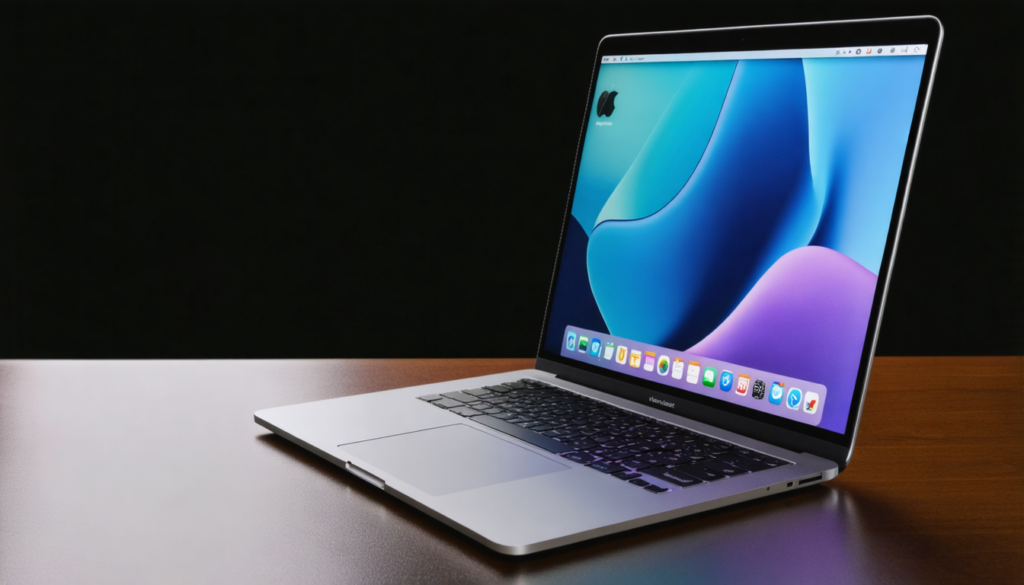
In an unexpected twist, Apple has just made a rare but far-reaching mistake: the name of its upcoming budget MacBook was prematurely leaked on its official website. This spectacular leak comes on the eve of a highly anticipated announcement scheduled for March 4, 2026, as tech enthusiasts worldwide eagerly await the refresh of the MacBook line. A regulatory document, designed for legal compliances, was temporarily published before being withdrawn. Nevertheless, it revealed the name “MacBook Neo,” a name that piques curiosity due to its originality and break from the conventions of the existing series.
This surprise revelation raises many questions. Between Apple’s marketing strategy, its product portfolio management, and the technical implications of this new device, the tech giant’s error sheds a new light on the imminent launch. Through this leak, the industrial challenges related to designing an affordable product, production cost hurdles, and user expectations that slightly deviate from high-end models also emerge. This digital mishap seems to open a door to a new era for Apple, at the crossroads of innovation and the democratization of computing technology.
- 1 A “MacBook Neo”: a name that marks a break in the Apple lineup
- 2 The almost official technical features of the MacBook Neo reveal a balance between performance and accessibility
- 3 What impact does this leak have on Apple’s commercial strategy?
- 4 The importance of an affordable MacBook to expand Apple’s market
- 5 A high-stakes pricing positioning: how does Apple balance costs and ambitions?
- 6 A week of intense announcements: context and stakes around the launch of the MacBook Neo
- 7 Perspectives and hypotheses on Apple’s long-term strategy regarding the MacBook Neo
- 8 Challenges and risks for Apple facing this accidental leak revealing the MacBook Neo
A “MacBook Neo”: a name that marks a break in the Apple lineup
The name “MacBook Neo” does not go unnoticed in the Apple ecosystem. Until now, Cupertino’s company has always structured its lineup around two well-defined models: the MacBook Air, appreciated for its lightness and mid-range positioning, and the MacBook Pro, focused on intensive performance for professionals. Introducing a “Neo” breaks with this tradition, perhaps suggesting a strategic repositioning or even a new philosophy.
This choice of designation, revealed by a technical compliance document bearing the model number A3404, does not resemble a simple terminology mistake. The word “Neo” indeed evokes renewal, a technological leap, and a breath of modernity. It is as if Apple is announcing a major change in its approach to the laptop market, especially for the budget category.
This development could indicate two things: either a product designed to redefine the standards of affordable machines, or a genuine test for Apple to widen its customer base. This unprecedented name in the MacBook series also highlights Apple’s desire to differentiate itself from competitors in a market saturated with affordable offers. It is a bold marketing gamble accompanied by a product strategy that we will explore in more detail.
Indeed, although it is rare for Apple to appear vulnerable to this type of mistake, it is all the more surprising that the very choice of a new name introduces a dilemma: who exactly is this MacBook Neo for? Will it directly compete with the MacBook Air, or will it propose an entry-level positioning aimed at students and users with limited needs? This potential confusion requires quick clarification, both for consumers and retailers. The risk would be to unnecessarily complicate an already well-developed range.
Moreover, some specialists suggest the possibility that “MacBook Neo” is merely an internal code name at Apple, used during testing phases and not intended for final commercialization. However, the official presence of the term on a public document strengthens the idea that this name, or a variant, may indeed be kept for commercial promotion. In any case, this choice marks a turning point in the communication around the entry-level products of the Californian giant.

The almost official technical features of the MacBook Neo reveal a balance between performance and accessibility
Beyond the name, the first leaks also shed light on the technical specifications of the MacBook Neo. According to the disclosed documents, this laptop would be equipped with an A18 Pro chip, identical to that of the iPhone 16 Pro, a very powerful version intended to guarantee smooth operation even on an affordable device. This choice reflects a clear Apple strategy aimed at optimizing the performance/price ratio for the budget target.
The screen, estimated at 12.9 inches, corresponds to an intermediate size, quite rare for a MacBook. This dimension seems designed to ensure a compromise between portability and visual comfort, suitable for school, office, or simple multimedia uses. The 8 GB of RAM as well as the base storage of 256 GB confirm the orientation towards typical daily use, without pretending to rival higher-end workstations.
However, one might question the sufficiency of 8 GB of RAM in the current technological context, notably in 2026, where built-in artificial intelligence and resource-demanding software are becoming the norm, even on entry-level machines. This capacity will therefore be subject to very optimized software management by macOS.
By comparison, the MacBook Air M5 starts at 1199 euros with 16 GB of RAM and 512 GB of storage, which places the MacBook Neo in a markedly more accessible lower category, without completely sacrificing performance. This positioning could appeal to a young clientele, students, or professionals looking for a secondary tool. Apple is betting on a product that democratizes its technologies while maintaining a certain quality of user experience.
Rumors indicate a price estimated between 600 and 800 euros, far below its bigger brothers. Nevertheless, several technical factors such as component availability, the cost of lithium batteries or memory modules, could significantly influence this price. This MacBook Neo thus draws a line between advanced technologies, industrial constraints, and the economic demands of the market.
What impact does this leak have on Apple’s commercial strategy?
This leak comes at a critical time for Apple. Cupertino’s company was supposed to officially unveil its new budget MacBook during an event scheduled for March 4, 2026. The premature announcement of the name due to an official website error could disrupt the carefully orchestrated communication plan.
The unexpected reveal of “MacBook Neo” now makes it difficult to control information about this product just days before its presentation. Apple, accustomed to a very strict choice of confidentiality and exclusivity, faces a situation where expectations are now focused on a name and partially confirmed technical features. This can play out favorably or unfavorably depending on public perception.
On the commercial side, this leak could increase interest in this model among tech-savvy consumers who are constantly looking for early news. But it could also create some confusion in the lineup, raising questions about the coherence of Apple’s offers.
It is also likely that Apple will have to adapt its marketing campaigns to respond to the speculations generated by this leak, explaining more precisely the exact position of this MacBook Neo compared to the MacBook Air and MacBook Pro. Care will need to be taken to clarify the technical innovations and usage segments, to avoid redundancies in the offer and brand dilution.
In summary, this mistake reveals both strong anticipation around the product and a rare failure in mastering timing at Apple, which could nevertheless capitalize on this forced spotlight to stimulate interest and anticipate consumer questions.
The importance of an affordable MacBook to expand Apple’s market
In 2026, the laptop market has become a highly competitive ground, marked by the rise of affordable and efficient options offered by other global players. Apple, historically positioned on premium products, therefore finds a clear strategic interest in opening up to a more accessible segment.
Consumer needs have evolved, combining mobility, connectivity, and multimedia efficiency, sometimes with a tighter budget. The MacBook Neo could thus play a crucial role by offering a reliable, agile, and sufficiently powerful product at an attractive price, notably appealing to students, young professionals, or less demanding users.
This budget model could also encourage a significant increase in Apple’s user base in geographical areas where purchasing power is more limited but brand loyalty and ecosystem remain strong. Enhanced accessibility via a competitively priced MacBook could strengthen the relationship between hardware, software, and services, a true growth driver over the long term.
The choice of an A18 Pro chip further illustrates the intention to combine advanced technology and cost control, thus maintaining a fine balance between innovation and economy. This strategy should also promote the adoption of office applications and learning tools integrating artificial intelligence, which are increasingly favored in professional and educational environments.
With a more affordable MacBook, Apple thus seeks to better meet diverse usage needs and profiles, consolidating its presence where competition has established itself thanks to often more affordable models.
List of potential advantages of the MacBook Neo for the budget market
- Competitive price allowing a wider audience access to the Apple brand
- Advanced technology with the A18 Pro chip, guaranteeing performance and energy efficiency
- Improved portability thanks to a moderately sized screen and compact design
- Software optimization to compensate for reduced RAM memory
- Increased appeal for students and beginner professionals
- Strengthening of the Apple ecosystem thanks to better integration in daily uses
- Reduction of the digital divide through an accessible price in emerging markets
The imminent arrival of the MacBook Neo could thus mark a turning point in Apple’s pricing policy and significantly broaden its target audience, while meeting the growing demands in terms of mobility and technological efficiency.

A high-stakes pricing positioning: how does Apple balance costs and ambitions?
Price remains a central point in the debate surrounding the MacBook Neo. While initial rumors mentioned a price potentially dropping as low as 599 dollars, the most recent estimates now place this price between 600 and 800 euros. A range that corresponds more to an accessible positioning, but without sacrificing the apparent quality of the user experience.
Several factors intertwine to prevent Apple from offering a very low price. The persistent shortage of RAM memory, a key component for performance and durability, heavily weighs on costs. Moreover, lithium batteries require cobalt, whose export remains subject to geopolitical and logistical tensions, also impacting manufacturing.
Apple therefore faces a strategic dilemma: should it aim for a price shock capable of shaking the budget segment, or favor a reasonable adjustment while maintaining profitability? Each option has its advantages, but also its risks. A price around 600 euros could cause cannibalization of MacBook Air sales, whereas a price closer to 800 euros would limit its appeal as a “cheap” machine.
Managing this equation promises to be complicated, as it will partly condition the commercial success of the MacBook Neo, while defining how Apple is perceived in this more price-sensitive market. The brand’s chosen strategy should reflect both a long-term vision and an ability to adapt to industrial constraints.
Finally, Apple will have to rely on its historical strength: the power of its hardware and software ecosystem, which, when well optimized, allows for a smooth user experience even with more modest hardware configurations. This strategy is a key lever to make this accessible MacBook viable and attractive.
A week of intense announcements: context and stakes around the launch of the MacBook Neo
The leak about the name MacBook Neo fits into a particularly busy schedule for Apple. Since early March 2026, the company has multiplied major announcements, strengthening its position across various product segments.
First, the iPhone 17e was unveiled as the entry-level model of the new generation, replacing the iPhone 16e in the catalog. Then, the iPad Air M4 arrived with a more powerful M4 chip, while maintaining a stable price, which highlights the renewal policy without inflation for certain key devices.
On March 3, 2026, Apple also unveiled the MacBook M5 Pro and M5 Max, targeting demanding professionals, alongside the MacBook Air M5 sold at 1199 euros. In this context, the MacBook Neo strategically completes the range, providing a more budget-friendly solution that can appeal to a broader and less demanding audience in terms of power but sensitive to mobility and price.
This multitude of announcements also illustrates Apple’s desire to cover all segments of the computing market, from general public users to the most specialized professionals. The MacBook Neo thus appears as the last piece of the puzzle, the one that could tip the balance towards increased democratization of Apple products.
These close announcements also highlight the complexity of commercial positioning, balancing innovation, costs, and accessibility. This context underscores the importance of the upcoming official presentation, which will need to address the many questions raised by the recent leak. The pressure is particularly high for Apple in this respect.
| Product | Processor | RAM | Storage | Indicative Price | Target Segment |
|---|---|---|---|---|---|
| MacBook Neo | A18 Pro | 8 GB | 256 GB | 600-800 € | Entry-level / Budget |
| MacBook Air M5 | M5 | 16 GB | 512 GB | 1199 € | Mid-range |
| MacBook Pro M5 Pro/Max | M5 Pro / M5 Max | 16-64 GB | 512 GB – 2 TB | 2100-3400 € | Professionals |
Perspectives and hypotheses on Apple’s long-term strategy regarding the MacBook Neo
The premature appearance of the “MacBook Neo” on Apple’s official website is much more than a simple communication error: it reveals a strategy in the making whose scope could extend beyond the product itself. Apple seems to want to reinvent the way it tackles the budget segment, with implications that could influence the computing landscape in the coming years.
First of all, one can imagine that this MacBook Neo is part of a broader desire to rethink modularity, design, and distribution of devices. One can envision a lighter, more durable device, or one using new display and battery technologies, allowing optimization of the quality/price ratio. The name precisely evokes this idea of a “new start,” of disruptive innovation.
In a world where competition is constantly reinventing itself, with players seeking to combine technological innovation and accessibility, Apple could find in the MacBook Neo a lever to increase its penetration in developing markets, but also to test a simplified, integrated, and less resource-hungry user experience.
From a commercial perspective, the successful launch of the MacBook Neo could serve as an example for other categories, encouraging diversification of Apple products towards segments long underexploited. This approach would also imply greater flexibility in the lineup, with better alignment between specific needs and offers, improving customer satisfaction.
Finally, on the technological front, the MacBook Neo could pave the way for new software and hardware optimizations, notably in local artificial intelligence or energy management, which could then be deployed on other Apple devices. An innovation that could redefine MacBook standards in the coming decade.
Challenges and risks for Apple facing this accidental leak revealing the MacBook Neo
This spectacular leak also has the consequence of placing Apple in a delicate situation, exposing the company to several risks but also strategic opportunities. One of the primary challenges is managing confidentiality and information control. Apple, known for its secrecy, now sees this cornerstone shaken.
This partial loss of control over product information can lead to uncontrolled speculation, unrealistic expectations, or even disappointment if official announcements do not match rumors. Such disorganization can damage the brand’s credibility, notably with investors and business partners.
Moreover, the leak can also reveal sensitive aspects regarding the lineup, questioning the segmentation strategy. The risk of cannibalization between models is heightened, creating a marketing challenge to clearly position each product. It is crucial for Apple to reassure and guide its customers through rapid and transparent communication.
However, this forced exposure can also be turned into an opportunity. Indeed, public and media reaction after such a leak can create positive buzz and increase interest before the official presentation. Apple could thus capitalize on this anticipated notoriety to boost visibility and spark debates around its innovations.
Managing this situation will require perfect coordination between technical, marketing, and communication teams to turn this challenge into a competitive advantage, strengthening the brand image and leveraging the genuine expectations stirred by the MacBook Neo.