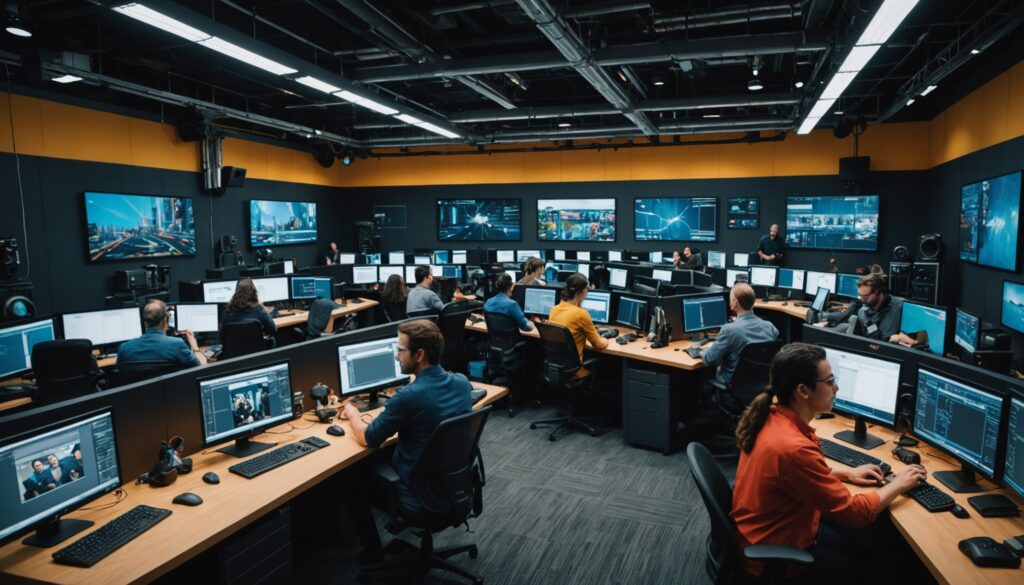
Amazon, digital and entertainment giant, is once again disrupting traditional norms by announcing its ambitious project to integrate artificial intelligence (AI) at the heart of film and series production. This decision, imminent as of March 2026, marks a crucial milestone in the audiovisual industry, which has so far been slowed down by lengthy and costly processes. By adopting these cutting-edge technologies, Amazon aims not only to optimize creation but also to accelerate the release pace of content, a strategy designed to meet a growing global demand.
Beyond the promise of innovation and efficiency, this approach nevertheless arouses a deep unease within the sector. Indeed, massively using AI for the conception of films and series raises major concerns about the future of creative professions, artistic quality, and the standardization of entertainment. How can disruptive technology be reconciled with respect for the very essence of cinema? The global-scale challenge questions the place of humans in an industry where creativity had until now been the cornerstone.
- 1 The revolution of audiovisual production thanks to artificial intelligence at Amazon
- 2 Amazon MGM Studios: a pioneering laboratory for AI in film and series production
- 3 Automation and acceleration of production: between promises and societal challenges
- 4 Social impact: job cuts linked to the rise of AI in cinema
- 5 Emergence of fierce competition among streaming giants for AI in entertainment
- 6 Towards a normalization of audiovisual content? Cultural stakes of AI in production
- 7 Technological innovations transforming film and series production at Amazon
- 8 Consequences for the public and cinema lovers: expectations and concerns?
- 8.1 How does Amazon use artificial intelligence in the production of films and series?
- 8.2 What are the main risks related to automated audiovisual production?
- 8.3 What is the impact of AI on jobs in the film industry?
- 8.4 How do professionals react to AI integration in production?
- 8.5 Can AI in audiovisual production guarantee artistic quality?
The revolution of audiovisual production thanks to artificial intelligence at Amazon
For several decades, cinema and television have remained domains where human creativity prevails, blending artistic talents, complex storytelling, and demanding technical achievements. Yet, at the dawn of 2026, Amazon boldly steps into a new era: that of AI-assisted audiovisual production.
The project was not born overnight. As early as summer 2025, Amazon MGM Studios founded a studio exclusively dedicated to developing and implementing proprietary AI tools. These technologies aim to automate the time-consuming stages of the production chain, from preproduction to postproduction, while ensuring the narrative and stylistic coherence of the works.
Specifically, artificial intelligence can today write scripts, edit scenes, generate visuals, or even simulate the presence of actors. This automation could significantly reduce production time and costs, which are often exorbitant in this industry. Amazon thus wants to offer films and series produced more quickly, with enhanced budget control.
This turning point can be seen as a true industrial revolution in the entertainment sector. Where formerly the production of a feature film could take several years, Amazon’s algorithms promise to condense these tasks into a few weeks or months. Through this system, the Seattle group hopes to multiply the delivery pace of new content on its platforms, thereby responding to the continuous consumption characteristic of current audiences.
But this technical innovation raises a key question: how to ensure that automation does not sacrifice the artistic and emotional depth inherent to human works? The challenge will be to imagine a subtle balance between robotic efficiency and sensitive creativity, which could completely redefine the audiovisual production model as we know it.
Amazon MGM Studios: a pioneering laboratory for AI in film and series production
With the creation of its AI studio, Amazon MGM Studios plays a pioneering role by offering an exclusive experimental ground for artificial intelligence applied to cinema and television. This internal laboratory concentrates sharp skills combining artistic expertise and technological innovation.
To carry out this mission, Amazon brings together a large-scale team of recognized experts, including director Robert Stromberg, famous for his visionary work on hits like Maleficent. The cast also includes actor Kunal Nayyar, globally known for his role in The Big Bang Theory, as well as Colin Brady, a major figure in animation through his career at Pixar. This group of creativity architects helps to guide the AI to produce content that maintains narrative and emotional coherence.
One of the studio’s main objectives is to use artificial intelligence to automate the major parts of the process, such as generating preliminary scripts, character modeling, or visual postproduction. For example, tens of thousands of video shots can be processed simultaneously, with real-time adjustments depending on the desired output.
A key partner in this adventure, Amazon Web Services (AWS) provides the computing power needed to train and run algorithms on a large scale. This technical support is essential, as the complexity of AI models requires colossal resources, often inaccessible to smaller studios.
Starting March 2026, a closed beta program is planned, where carefully selected partners will be able to test these new tools in real shooting conditions. This upward phase will allow measuring the relevance of the algorithms in a concrete environment, potentially paving the way for wider adoption across the industry.
Automation and acceleration of production: between promises and societal challenges
The massive introduction of AI in audiovisual production is primarily intended to streamline manufacturing steps and drastically reduce lead times. Amazon heavily bets on automation to speed up the release of films and series, in a market where demand is exponential and public attention increasingly volatile.
Thanks to these innovations, directors and technical teams could see their workload lightened, as some repetitive or tedious tasks are entrusted to machines. If the script generation software can draft a basic storyline, AI can also simulate virtual environments, reducing the costly use of physical sets.
- Cost optimization: Significant reduction in expenses related to technical teams and hardware infrastructures.
- Speed gain: Accelerated completion of the different phases, from planning to final editing.
- Improved coherence: Algorithms ensuring the continuity of characters and narrative arcs.
- Creative flexibility: Real-time adjustments possible according to feedback and market trends.
Yet, these upheavals are not met with unanimous enthusiasm. The fear of a massive replacement of sector professionals particularly worries unions, which denounce a rapid transformation of work methods imposed without consultation. Automation risks bypassing human artistic skills in favor of mechanical and standardized production.
Albert Cheng, spokesperson for Amazon Studio AI, however defends the official position of the American giant: AI tools are designed to complement human talents, not to replace them. The challenge is to speed up production while ensuring that the creative essence always comes from humans. However, the boundary between assistance and replacement remains blurred in a sector where creativity is difficult to quantify.
Social impact: job cuts linked to the rise of AI in cinema
In concrete reality, Amazon’s technological advances occur in a tense social context. At the end of 2025 and early 2026, the group announced massive job cuts, totaling more than 30,000 positions, partly justified by efficiency gains induced by artificial intelligence.
This aspect is not trivial. It reflects a profound change in the functioning of studios and poses a major challenge for society. The eventual replacement of traditional roles by algorithmic automation feeds fears of increased precariousness among cultural sector workers.
Critics highlight that AI is no longer merely an assistant but becomes an accounting instrument justifying the progressive eviction of humans. This phenomenon recalls debates about the transformation of professions since the advent of new technologies in various industries, with an obvious risk of dehumanization.
Another point of vigilance concerns the quality of creation. The unpredictable, the imperfect, and subjectivity are often the elements that transcend an audiovisual work. When machines are programmed to maximize productivity, these nuances could be lost, raising questions about the artistic future of cinema.
Emergence of fierce competition among streaming giants for AI in entertainment
It would be illusory to think that Amazon is isolated in this technological race. Its rivals, notably Netflix, are already deploying similar strategies. For example, Netflix has been using generative AI for several months to optimize certain spectacular scenes, like in The Eternaut, where a building collapse sequence was created thanks to algorithms.
This dynamic creates intense pressure on other market players, all eager not to lose ground in a shifting industry, dominated by high-speed consumption and an insatiable thirst for new content. The risk is that the standardization of content pushes toward a homogenization of works, neglecting diversity and originality.
The following table summarizes the major strengths and risks related to AI adoption in film and series production among different players:
| Criteria | Amazon | Netflix | Other Studios |
|---|---|---|---|
| Investment in AI | Very high, with AI studio and beta program from 2026 | Progressive integration since 2025, generative AI in postproduction | Rapid growth but less structured |
| Automation | Wide automation: scripts, editing, characters | Focused automation on visual effects scenes | Partial automation on technical aspects |
| Social impact | Massive job cuts justified by AI | Reduction of technical teams and artists | Variable resistance depending on studios |
| Creative quality | High risks of standardization | Efforts to maintain original creativity | Diverse experimental approaches |
Towards a normalization of audiovisual content? Cultural stakes of AI in production
One of the hottest debates surrounding the growing use of artificial intelligence in audiovisual production concerns cultural diversity and the richness of tomorrow’s content.
If AI responds to algorithmic and economic logics, it naturally tends to favor proven formulas and calibrated hit recipes for the greatest number. This optimization can lead to homogenization of the stories told, to the detriment of original or marginal voices.
This dynamic worries because it could transform cinema, traditionally a fundamental element of cultural identity, into a standardized product consumed quickly then forgotten.
Cultural protectionists warn of risks related to the growing centralization of creative processes, in the hands of a few multinationals controlling computing infrastructures and artistic databases. Creativity, in its purest sense, is exposed to new forms of commodification, where works are more algorithms than human expressions.
In this context, some artists and collectives develop experiments to reinject a human dimension into AI-assisted cinema, by inserting intentional imperfections or promoting hybrid collaborations between humans and machines. This could be the way to combine the best of both worlds.
Technological innovations transforming film and series production at Amazon
At the heart of this revolution are innovative technologies redefining how films and series are made. Amazon integrates several advanced tools to improve each creation phase:
- Automated script generation: Algorithms capable of proposing coherent scenarios adapted to project needs, reducing writing time.
- 3D modeling and assisted animation: Rapid creation of characters and virtual environments for previsualization and animation.
- Intelligent editing: AI software capable of selecting the best takes and assembling sequences according to the desired narrative pace.
- Automated special effects: Production of complex scenes such as explosions or natural disasters through digital simulations.
- Predictive audience analysis: Tools evaluating public trends and preferences to guide creation toward more engaging content.
These technologies combine into a dynamic and integrated ecosystem, supported by AWS’s massive computing power, ensuring speed and quality. They transform traditional production into a smoother process, allowing real-time adaptation based on audience feedback.
Consequences for the public and cinema lovers: expectations and concerns?
For viewers, the rise of AI in audiovisual creation causes a mix of excitement and caution. On one hand, the prospect of access to a multitude of innovative content, produced faster and often cheaper, is promising. This could open new forms of narrative experience, where interactivity and personalization play an increased role.
However, many fear that these productions could become too uniform, lacking that human touch that makes each work unique. Emotion, originality’s grain, mistakes, and artisanal imperfections are often seen as essential to the success of a film or series.
Moreover, transparency about the real share of AI in each project will remain a crucial issue. The public might demand to be informed if a work is entirely generated or heavily assisted by algorithms, strengthening trust and enabling an informed choice.
Finally, the question of access to these technologies could be decisive. If only major platforms like Amazon can afford these investments, it could increase inequalities in the industry, to the detriment of independent creations and emerging voices.
How does Amazon use artificial intelligence in the production of films and series?
Amazon created a studio dedicated to integrating AI tools in various production phases, from scriptwriting to postproduction, to speed up the process while controlling costs.
Risks include job cuts, content standardization, loss of human creativity, and precariousness of sector professionals.
What is the impact of AI on jobs in the film industry?
Automation is already leading to massive team reductions, with over 30,000 positions cut at Amazon directly linked to the rise of AI.
How do professionals react to AI integration in production?
Unions and artists express concerns, denouncing a forced shift in work methods and possible loss of artistic identity of works.
Can AI in audiovisual production guarantee artistic quality?
At this stage, AI improves efficiency but cannot yet reproduce the human imperfection that constitutes the emotional and artistic richness of films and series.