
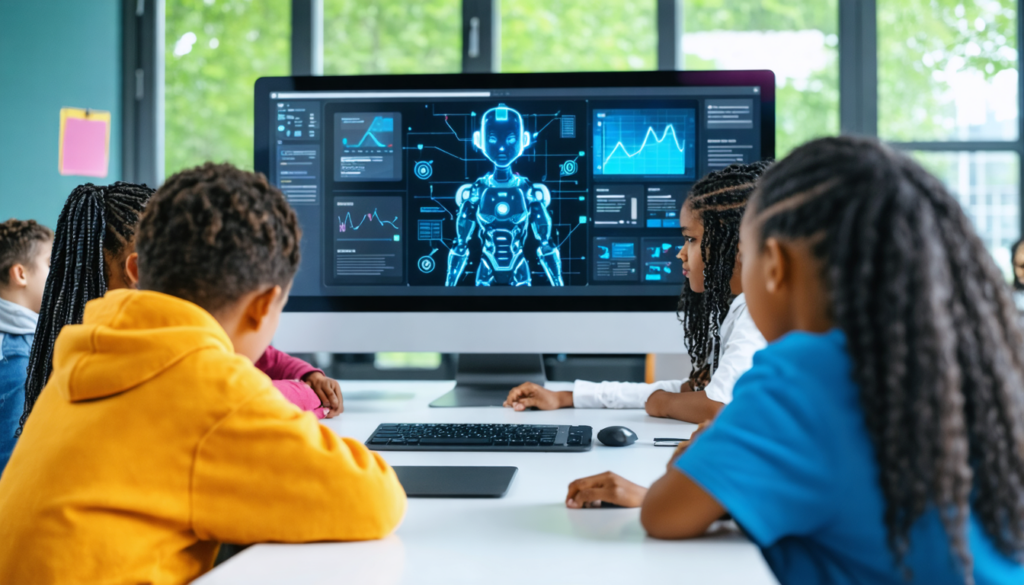
At a time when digital transformation is redefining communication methods, AI avatars are becoming key players in this revolution. These intelligent digital representations, capable of conversing, presenting, and interacting, symbolize a new era where immersive technology pushes the boundaries of creativity and efficiency. By 2026, the digital adoption of these tools is no longer a mere niche phenomenon but a major trend disrupting diverse sectors, from digital marketing to professional training.
In the face of this dynamic, understanding what an AI avatar is and mastering its use becomes essential for any organization or creator wishing to stay at the forefront of innovation. The innovations of 2026 now make it possible to design incredibly realistic virtual characters, capable of speaking multiple languages, adapting their speech, and integrating easily into digital campaigns. This article invites you to dive into this new universe, where artificial intelligence offers an unprecedented virtual interaction with audiences, and to discover a practical guide to smartly adopt this technology.
- 1 In-depth definition of an AI avatar and its operation in 2026
- 2 Key uses of AI avatars in marketing and digital communication
- 3 Integration of AI avatars in digital training and education
- 4 How to create an AI avatar: recommended steps and tools for 2026
- 5 Major advantages of AI avatars in productivity and digital efficiency
- 6 Limitations and precautions in using AI avatars in a professional context
- 7 Development perspectives and trends around AI avatars in 2026
- 8 Comparison of the best AI avatar solutions in 2026
- 9 Fully exploiting AI avatars: practical advice for successful adoption
In-depth definition of an AI avatar and its operation in 2026
An AI avatar, far from being reduced to a simple animated image, is a sophisticated digital creation integrating several artificial intelligence technologies. Its essence lies in its ability to embody a human or fictional character with an impressive level of visual and sound realism. Thanks to advances in deep learning algorithms, these avatars can now imitate facial expressions, synchronize lip movements with a synthetic voice, and adjust their intonation according to context.
Their complex architecture relies on several major technological building blocks:
- Deep learning for facial animation and realistic gestures, enabling the reproduction of micro-expressions that convey emotions;
- Advanced voice synthesis, offering a varied, customizable vocal palette, multiplying possibilities for linguistic and stylistic adaptation;
- Natural language processing (NLP) equipping certain avatars to respond in real time, pertinently, to complex questions;
- 3D or 2D modeling depending on the avatar type, ranging from near-photographic realism to more stylized designs;
This combination guarantees a virtual interaction that goes far beyond static images or simple traditional animation. Thus, an AI avatar can fully replace, complement, or amplify a human presence in various contexts. Their usage flexibility allows them to address a diverse audience directly, while maintaining emotional coherence and fine personalization of the message.
For example, a company can create an AI avatar for commercial support: the character will explain products with speech adapted to the customer profile and in the target language. The same avatar, used in internal training, can present educational content while remaining accessible and dynamic, without the fatigue or logistical constraints of a human instructor. This technical potential reflects the future of AI, designed for an inclusive and efficient digital transformation.
Key uses of AI avatars in marketing and digital communication
In the field of digital marketing, the adoption of AI avatars revolutionizes the way companies engage their audiences. Their ability to personalize content, combined with a multi-channel capacity, makes them true message amplifiers. Today, an AI avatar no longer just reads a text; it becomes a dynamic interlocutor capable of capturing attention and establishing an emotional connection with the consumer.
The sectors where AI avatars have taken a central place notably include:
- Relationship marketing: improving engagement rates through personalized videos where the avatar directly addresses the target;
- E-commerce: interactive product presentations explaining their benefits with adapted speech;
- Multilingual campaigns: broadcasting without the need to reshoot thanks to voice synthesis and lip synchronization;
- Customer relations: avatars integrated into visual chatbots, offering a more human experience;
This digital personalization allows brands to refine their communication and build a consistent visual and sound identity across all media. For instance, an international franchise can deploy the same avatar in multiple languages, thus ensuring message uniformity while respecting local cultural specificities.
AI avatars also promote corporate storytelling, making content more accessible and memorable. Recent studies show that explanatory video consumption with an avatar significantly increases information retention compared to plain text or traditional video. Working with an AI avatar proves to be an effective strategy to boost visibility and brand awareness.
Moreover, using avatars on social networks helps maintain a high publication rhythm while ensuring brand consistency. Marketing content creators thus gain productivity without sacrificing quality or originality.
Integration of AI avatars in digital training and education
Education has been deeply impacted by the rise of artificial intelligence technologies, and AI avatars now occupy a strategic place in this sector. Their ability to offer engaging and personalized virtual interaction creates a new pedagogical dimension, sometimes inaccessible with traditional methods.
Concretely, AI avatars are involved in several scenarios:
- E-learning modules: an avatar presents a lesson, rephrases concepts, and adjusts tone according to the learner’s level;
- Professional training: dynamic media explaining procedures, safety measures, or best practices;
- Individualized support: certain AI avatars equipped with NLP can answer frequent questions in real-time, offering personalized tutoring;
- Accessibility: thanks to multilingual avatars, training can be offered to an international audience without language barriers;
This pedagogical flexibility not only amplifies the reach of training but also adapts content to the pace and specific needs of each learner. A company can thus use an avatar to standardize the training of its teams, even when geographically dispersed, while ensuring a high level of engagement.
Time savings are also notable: no more need to organize in-person sessions or mobilize an expert each time a point needs clarification. Content is easy to update, and the avatar always maintains a professional and available posture.
These qualities make the AI avatar a tool of choice for continuing education, where regularity and quality of information are paramount. They also allow the imagining of innovative immersive learning scenarios, merging virtual reality and artificial intelligence.
How to create an AI avatar: recommended steps and tools for 2026
Creating an AI avatar, accessible to both beginners and experts, has greatly simplified thanks to innovations in dedicated platforms. The process can be summarized in several key steps:
- Appearance choice: realistic, stylized, 2D or 3D, according to use and target.
- Trait creation or import: some software allows generating an avatar from photos, videos, or from scratch with templates.
- Script writing: text that will be interpreted by the avatar, possibly including multiple languages and tones.
- Voice configuration: selection of an available synthetic voice or cloning from a real voice, with settings to ensure fluidity and naturalness.
- Animation and synchronization: adjustment of facial expressions, movements, and automatic lip synchronization by AI.
- Export and integration: saving in formats adapted for social networks, websites, or educational media.
Among the popular tools in 2026 is HeyGen, known for its ease of use and very professional rendering. Other notable solutions include Synthesia, Reallusion, and Character Animator, each with specificities suited to different needs. Platform choice mainly depends on objectives, budget, and expected level of customization.
These platforms often include libraries of ready-to-use avatars, with the possibility to modify details for advanced personalization. This saves precious time, especially when it comes to quickly deploying campaigns or educational content.
However, it is crucial to adopt a strategic approach, ensuring that the avatar integrates harmoniously into the overall communication strategy. Improper use can damage brand image or cause emotional disconnection with the audience.
Major advantages of AI avatars in productivity and digital efficiency
AI avatars bring tangible benefits in terms of productivity and efficiency, especially in a professional environment where time and quality are critical resources. Their deployment notably allows:
- Accelerated content production: an avatar can generate in a few minutes what would normally require hours of shooting and editing;
- Message standardization: ensuring perfect consistency across all produced videos, regardless of the channel;
- Substantial cost savings: elimination of costs related to studios, travel, or speaker fees;
- Impressive scalability: the ability to multiply linguistic versions and formats without constraints;
- 24/7 availability: the avatar knows neither breaks nor fatigue, guaranteeing permanent access to content.
These points significantly enhance companies’ ability to maintain a constant and qualitative digital presence. In particular, tool standardization reduces human errors and ensures a consistent user experience.
For example, in the training sector, an AI avatar can be deployed simultaneously for multiple groups worldwide without any degradation in teaching quality. This flexibility perfectly illustrates how these technologies support innovation and optimization processes.
Limitations and precautions in using AI avatars in a professional context
Despite their benefits, AI avatars have certain limitations to consider to avoid potential pitfalls. First of all, although the quality of facial and vocal animations is rapidly improving, emotional realism sometimes remains insufficient to handle very nuanced or sensitive topics.
Moreover, excessive dependence on these tools can give an overly robotic impression, generating rejection or disengagement from audiences. It is therefore essential to integrate these technologies as complements to human communication and not as total replacements.
Another limitation concerns privacy and ethics. Some avatars are created from biometric data, which requires increased vigilance regarding the use of personal data and consent respect. Their use must always comply with current regulations and guarantee complete transparency towards users.
Finally, although highly advanced, personalization cannot resolve all adaptation requirements, especially in complex intercultural contexts or when human creativity is central. Knowing how to balance technology and human sensitivity remains a key skill to fully leverage this innovation.

Development perspectives and trends around AI avatars in 2026
The field of AI avatars continues to evolve rapidly, continuously integrating new features. Among the major trends relevant in 2026 are:
- Stronger integration with virtual and augmented reality, offering immersive experiences where the avatar becomes a guide or interactive partner;
- Advances in emotional artificial intelligence to improve recognition and expression of emotions;
- Advanced personalization through machine learning, allowing the avatar to learn and adapt its behavior based on past interactions;
- Development of hybrid avatars combining captured human presence and AI processing for even greater realism;
- Increased automation in generating personalized, dynamic content, facilitating decision-making;
These developments signify a real revolution in virtual interaction and digital communication. The future of AI is marked by an ever closer hybridization between human creativity and technological performance, placing AI avatars at the heart of this transformation.
Comparison of the best AI avatar solutions in 2026
The market in 2026 offers several options suited to various requirements. The table below summarizes the main tools, their uses, and key features:
| Platform | Avatar type | Customization | Available languages | Recommended use | Indicative price |
|---|---|---|---|---|---|
| HeyGen | Realistic 2D and 3D | High (face, voice, expressions) | More than 20 | Marketing, training, corporate communication | Monthly subscription model (variable depending on options) |
| Synthesia | 2D avatar videos | Medium (voice and appearance choice) | 30+ | Explanatory videos, educational content | Monthly or per-video package |
| Reallusion | Customizable 3D avatars | Very high (advanced animation) | Varies depending on integrated voices | Video games, virtual reality, immersion | One-time purchase or subscription |
| Character Animator (Adobe) | Animated 2D avatars | Customization via video capture | Limited (depends on third-party synthetic voices) | Professional animation, streaming | Adobe Creative Cloud subscription |
Fully exploiting AI avatars: practical advice for successful adoption
To make the most of AI avatars, it is essential to adopt a methodical approach aligned with your strategic objectives. Here are some recommendations based on successful practices in 2026:
- Assess real needs before launching a project, clearly identifying uses (training, marketing, e-commerce, etc.);
- Choose an avatar consistent with your image: the virtual personality must reflect brand identity;
- Invest in quality scripts and voice, as these are the elements that guarantee authenticity and warmth of the message;
- Regularly test content with target users to adjust tone, expressions, and any details;
- Integrate the AI avatar into a mix of various channels, combining video, social networks, educational platforms, and websites;
- Respect confidentiality and ethical standards, notably by explaining avatar use to your audience;
- Train teams to master avatar creation and animation;
- Do not completely replace humans but use avatars to complement and enrich digital interaction;
These guidelines ensure responsible and effective digital adoption. They avoid frequent mistakes linked to overly mechanical or impersonal avatar use while maximizing their impact.
What is an AI avatar?
It is a digital representation animated by artificial intelligence, capable of simulating expressions, speaking, and interacting with an audience in multiple languages.
Which sectors benefit most from AI avatars?
The marketing, training, e-commerce, and digital communication sectors gain significant benefits from this immersive technology.
What are the most popular tools to create an AI avatar?
Among the 2026 solutions, there are HeyGen, Synthesia, Reallusion, and Character Animator, offering different options depending on needs.
Can AI avatars completely replace humans?
They are designed to complement and optimize human communication but do not completely replace the emotion and spontaneity of a real interlocutor.
How to ensure good adoption of AI avatars?
It is necessary to align their use with the overall strategy, personalize content, respect ethics, train teams, and maintain balance with human communication.




