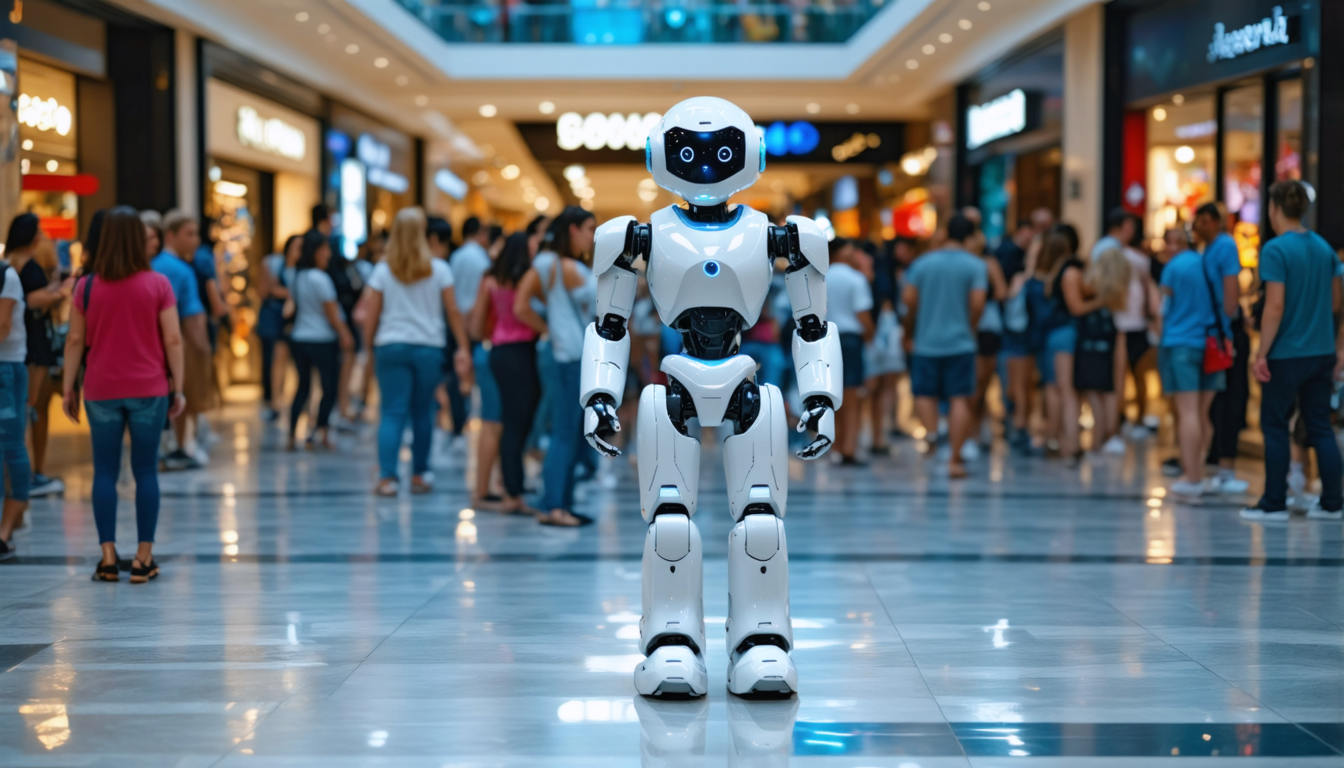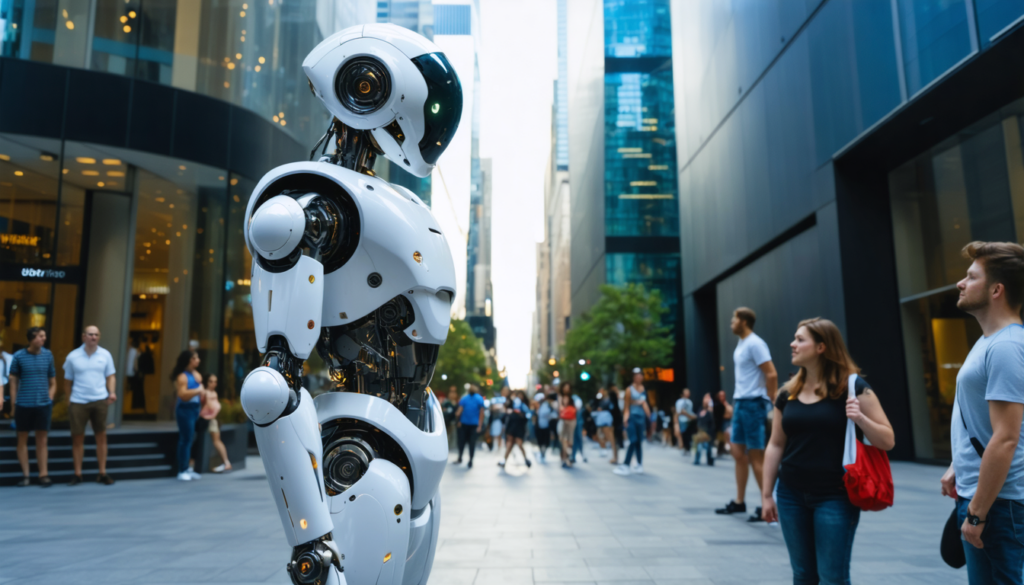
In the technological bustle of Shenzhen, a particular event recently captured widespread attention: the humanoid robot IRON from the company Xpeng established itself as the new star of a very busy shopping mall. With its almost human appearance, smooth movements, and spontaneous interactions with visitors, this robot embodies the most advanced innovation in artificial intelligence and robotics. Yet, this futuristic spectacle did not unfold without surprise: a spectacular fall, widely captured by witnesses’ smartphones, propelled IRON to the forefront of the global stage, generating tremendous buzz on social media. This spotlight reveals both the technological prowess achieved by Xpeng and the ongoing challenges posed by humanoid robotics, especially in terms of balance and autonomy.
This carefully orchestrated parade aimed to establish IRON as a tangible symbol of mature technology, ready to leave the laboratory to integrate into our daily lives, especially in commercial environments and, ultimately, residential ones. But the unexpected fall that occurred in the heart of the shopping mall reminded us that robotics is a field where every progress is hard to master. Beyond the incident, this encounter between man and machine embodies a genuine breakthrough in intelligent interaction and paves the way for concrete applications in various sectors.
- 1 A Captivating Demonstration of the Xpeng Iron Robot at Shenzhen Shopping Mall
- 2 The Revolutionary Human Design Aspect of the Xpeng Iron Robot
- 3 Technical Specifications and Advanced Technical Sheet of the Xpeng Iron Robot
- 4 Technical Limits Revealed by the Fall of the Humanoid Robot IRON
- 5 Reinventing Interaction: How Xpeng Capitalizes on Artificial Intelligence
- 6 Commercial and Societal Stakes Related to the Integration of Humanoid Robots in Public Spaces
- 7 A New Interaction Management Strategy Following the Public Demo and Fall
- 8 Future Perspectives and Expected Innovations in Humanoid Robotics
A Captivating Demonstration of the Xpeng Iron Robot at Shenzhen Shopping Mall
The scene is set: a very lively shopping mall in the very heart of Shenzhen, China’s capital of technological innovation. The humanoid robot IRON makes its appearance in this public space, immediately creating an impressive visual and emotional spectacle. This robot does not simply walk. It interacts with visitors, asking questions and mimicking expressions that can induce a form of empathy in spectators. Its parade through the crowd is designed to demonstrate the fluidity of its movements and the capability of its artificial intelligence algorithms to manage real-time interactions.
Its gait imitates that of a model on a runway, with a spine offering five degrees of freedom and a revolutionary hip architecture for a bipedal robot. This advanced technology not only allows the reproduction of very natural human movements but also ensures a certain dynamic stability, despite the constant challenges of humanoid robotics in terms of balance. These technical features were intended to reinforce the impression of a robot ready for daily use, notably in stores seeking to offer unprecedented interactive experiences to their clientele.
However, even the most experienced engineers must cope with the unpredictable. Just after crossing an captivated audience, the robot lost its balance and fell backward, an incident that surprised everyone. This misstep, far from discrediting the project, demonstrated the complexity of the systems involved and reminded how humanoid robotics is an unparalleled balancing act challenge.
The Revolutionary Human Design Aspect of the Xpeng Iron Robot
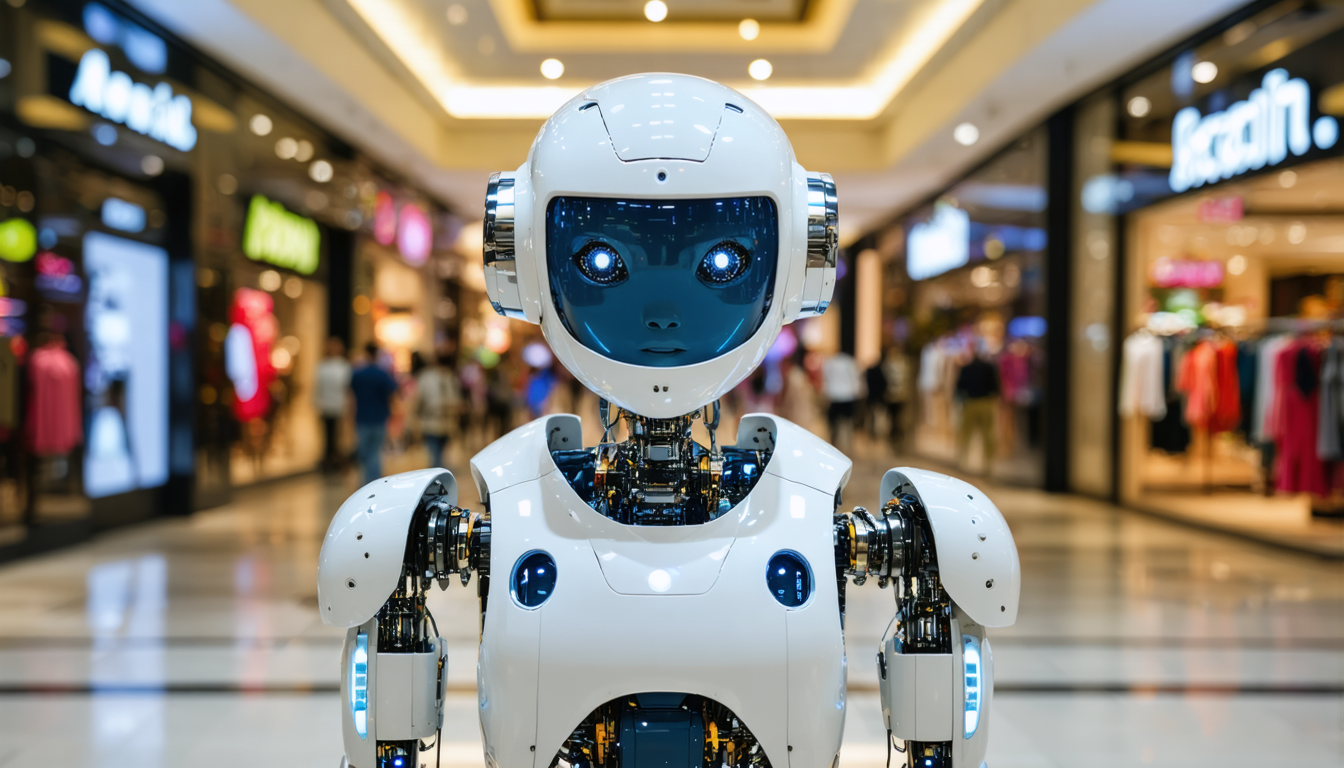
What sets IRON apart from other humanoid robots is undoubtedly its striking resemblance to human anatomy, both visually and mechanically. Unlike classic industrial robots with a metallic and rigid appearance, IRON sports a synthetic skin faithfully reproducing human texture. This casing plays a crucial role in softening the technical aspect of the robot, encouraging visitors to adopt a less wary gaze and favor spontaneous interaction.
The spine equipped with five degrees of freedom not only ensures an upright posture but also contributes to fluidity of movements, mimicking human suppleness. This advanced articulation is complemented by an internal structure called artificial fascia, 3D printed and designed to imitate human musculature. This unique layer absorbs vibrations and avoids jerky gestures that often give a clumsy robotic look. These innovations allow IRON to adopt a gait reminiscent of a model, greatly facilitating its acceptance in a public environment.
Another notable point, often emphasized by observers, is IRON’s dynamic facial expressiveness. Equipped with a screen capable of projecting various expressions, the robot can adapt its face according to exchanges with humans, thereby reinforcing the feeling of a real, interactive, and warm interaction. This visual adaptation capability is not trivial; it corresponds to a genuine advance in the creation of social robots intended to operate closely with humans in the future.
Technical Specifications and Advanced Technical Sheet of the Xpeng Iron Robot
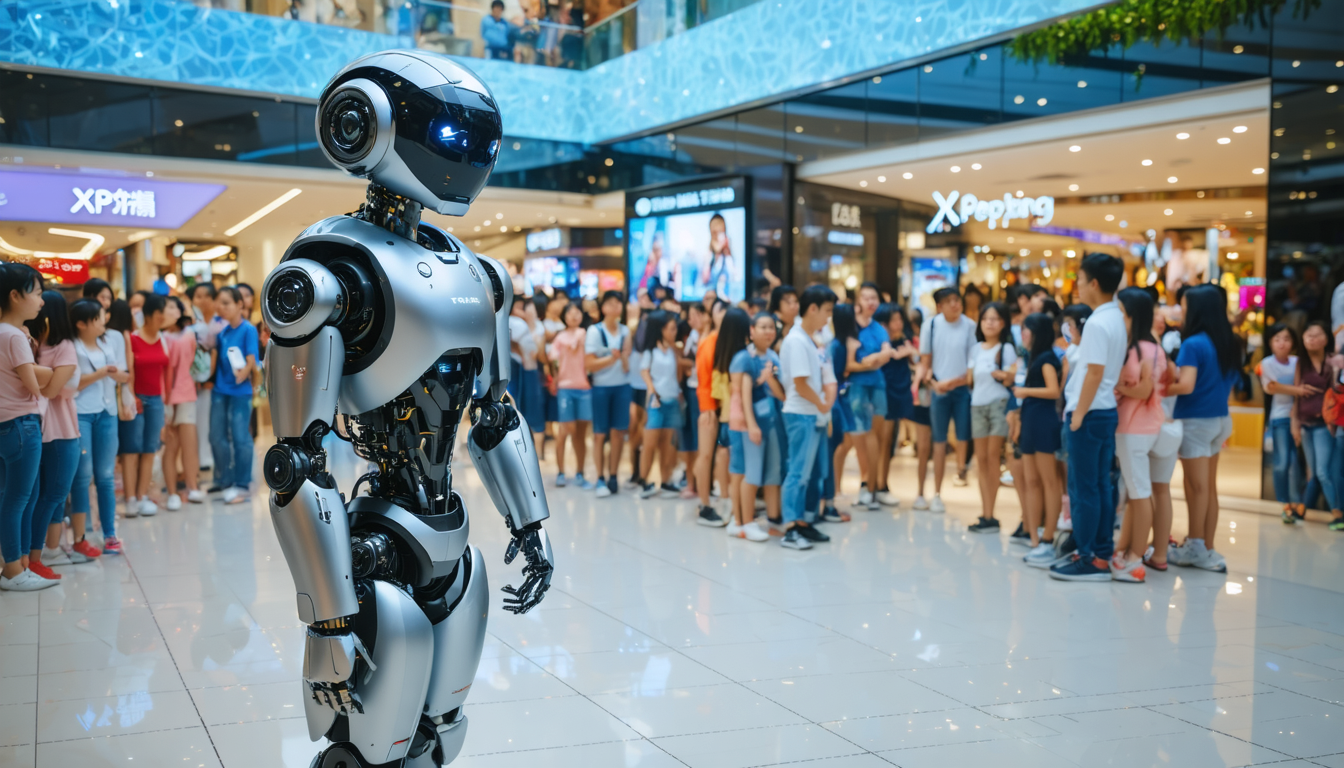
In terms of measurements, IRON displays classic human characteristics: a height of 1.78 meters and a weight of 70 kilograms, giving it an imposing but reassuring presence in public spaces. This robot incorporates an internal structure reproducing muscular anatomy with realism down to the synthetic muscles that contract and stretch to generate natural movements.
Special attention has been given to its 62 active joints, each controlled with remarkable flexibility. Its hand, for example, has 22 degrees of freedom, allowing it to delicately manipulate both fragile objects and heavier loads. This versatility opens the way to many practical applications, such as assisting humans in daily tasks or professional environments, where precision and delicacy are essential.
Computing performance relies on three Turing artificial intelligence chips, capable of processing up to 2,250 billion operations per second. Coupled with the Vision-Language-Action system, this central processor perfectly integrates visual perception with motor commands in real-time, making interactions more natural and adaptive. Finally, the embedded semiconductor battery significantly reduces heat production and increases energy safety, a crucial point for integrating IRON into public places.
| Feature | Detail | Advantage |
|---|---|---|
| Height | 1.78 m | Close to average human height |
| Weight | 70 kg | Stable and reassuring for interactions |
| Number of joints | 62 active joints | Great movement flexibility |
| Degrees of freedom hands | 22 degrees | Precise and delicate manipulation |
| AI processors | 3 Turing chips | Ultra-fast data processing |
| Battery | Semiconductor-based | Less heat, better safety |
Technical Limits Revealed by the Fall of the Humanoid Robot IRON
The demonstration offered at the Shenzhen shopping mall, despite its futuristic aesthetics, highlighted a persistent reality in humanoid robotics: balance remains a major challenge. IRON’s spectacular fall has become a textbook case for understanding the difficulties linked to mastering movement and dynamic control of bipedal robots.
In a society that increasingly values machine autonomy, this type of incident reminds us that adapting to unforeseen events, such as sudden terrain changes or a disruption of the center of gravity, requires fine coordination between motors, sensors, and control algorithms. Even though IRON can theoretically walk up to two meters per second, stopping abruptly or adjusting its posture represents a difficult exercise and often a source of errors.
This robotic fragility underlines the advances still needed in fields such as fine sensory perception, predictive motor control, and rapid reaction capacity. However, the observed phenomenon should not be seen as a failure but as an essential step in the maturation of this complex and demanding technology.
Reinventing Interaction: How Xpeng Capitalizes on Artificial Intelligence
At the heart of this innovation, artificial intelligence is not only a computation system; it is the main engine of interactions between IRON and visitors. The robot uses a Vision-Language-Action system linking visual perception, natural language understanding, and motor execution in real-time. This process allows adapting communication according to human reactions, making each encounter unique and dynamic.
This adaptability is particularly highlighted in a place like a shopping mall where the diversity of interactions is enormous. IRON knows how to ask questions, recognize the emotional tone of interlocutors, and modify its facial expressions to match the conversation’s atmosphere. This relational richness fosters an immersive user experience and appeals to a wide audience, from children to adults.
Visitors were thus able to experience a robot capable of a genuine conversation, no longer limited to merely executing pre-recorded commands but engaging in a living interaction shaped by onboard artificial intelligence. This evolution represents a decisive step towards robotic assistants able to integrate naturally into our daily environments.
Commercial and Societal Stakes Related to the Integration of Humanoid Robots in Public Spaces
The choice of Shenzhen as the stage for this demonstration is no coincidence. As a leading technology city in China, Shenzhen offers a favorable environment to test and optimize ambitious technologies like IRON. Operating in a commercial space also allows collecting valuable data on interactions, visitor reactions, and performance in real conditions.
Xpeng is considering a commercial rollout starting in 2026, initially targeting retail stores. The objective is to offer robots capable of assisting customers, providing personalized services, and enriching the client experience. In the longer term, this type of robot might enter homes, providing help with various domestic tasks while being an interactive companion.
However, this technological shift also raises important questions. Social acceptance of humanoid robots requires communication and regulation efforts to build trust. Data privacy management, security, and ethics in robotic interventions are at the heart of growing debates in political and industrial spheres.
A New Interaction Management Strategy Following the Public Demo and Fall
In response to the fall in front of the visitors, Xpeng quickly adjusted its strategy to enhance the safety of public demonstrations. The next day, IRON was presented with an external support system, limiting its movements and focusing on more controlled interactions. This decision aims to demonstrate the company’s seriousness in the secure development of its products and its willingness to progress taking field feedback into account.
Interactions thus focused on playful and educational exchanges, especially with children, asking questions, telling anecdotes, and evoking wonder without trying to impress by risky movements. This cautious approach facilitates acceptance and reduces risks while letting the robot’s future potential shine through.
This evolution reflects maturity in the design and implementation of humanoid robots, where technology does not take precedence over safety and a positive user experience. The virality of the fall video has thus become a constructive brake to perfect innovation.
Future Perspectives and Expected Innovations in Humanoid Robotics
The case of IRON clearly illustrates that humanoid robotics is a discipline in perpetual development. Technical challenges such as stability, fluidity of movement, and natural interaction must be addressed by integrating increasingly sophisticated technologies. For 2026 and beyond, several avenues open up.
- Improvement of dynamic control algorithms: to anticipate and quickly correct imbalances.
- Development of more sensitive tactile sensors: which will allow adjustment of movements based on environmental feedback.
- Deeper integration of artificial emotional intelligence: to enrich human-robot interactions.
- Energy optimization: thanks to more efficient and safer batteries for extended autonomy.
- Standardization of safety protocols: to strengthen trust in the use of robots in public spaces.
Each of these advances fits into a global approach aimed at making humanoid robotics not only technically viable but also socially acceptable and economically profitable. China, with companies like Xpeng, plays a key role in this global dynamic by leveraging its industrial capabilities and domestic market to accelerate large-scale commercial deployment.