
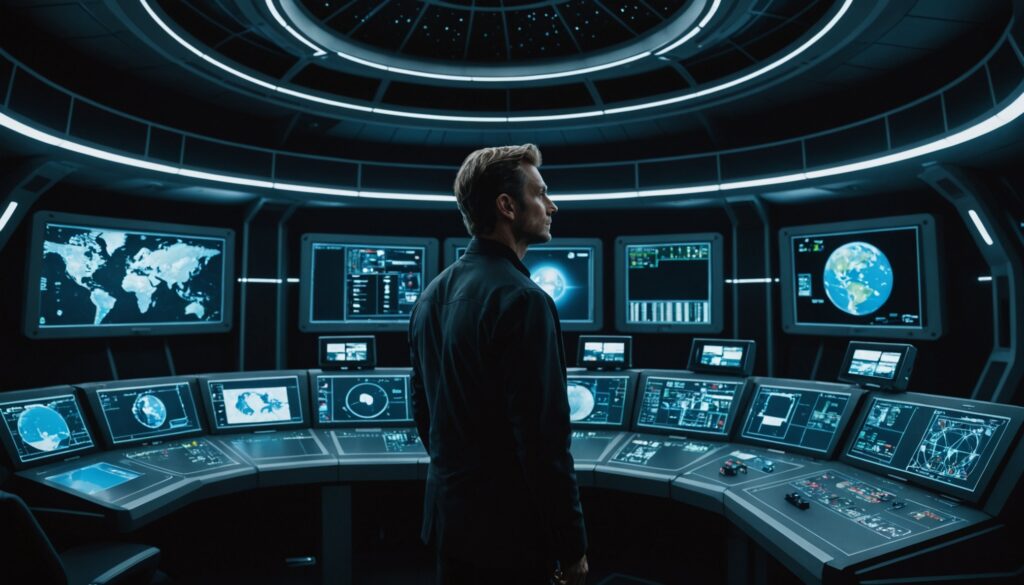
Elon Musk, visionary entrepreneur, has just reached a new major milestone in the convergence between space and artificial intelligence. On February 2, he announced the merger of his two leading companies, SpaceX and xAI, a monumental operation estimated at several hundred billion dollars. This initiative reflects a bold ambition: to establish data centers directly in orbit, a revolutionary concept destined to redefine the standards of space technology and the exploitation of satellites for the AI era.
As the energy demand related to AI explodes, Musk proposes to go beyond terrestrial limits by relying on his space expertise, notably through the Starship constellation and a massive network of satellites in orbit. This project called “Sentient Sun” could pave the way for a true technological breakthrough, disrupting both space infrastructure and planetary uses. For Musk, it is a decisive step toward an ultra-connected civilization, capable of exploiting solar energy on an unprecedented scale and laying the foundations for a complete space conquest.
The alliance between the power of SpaceX and the expertise of xAI thus promises to change the way we collect, process, and distribute information, leveraging the proximity of space to improve efficiency, speed, and eco-responsibility. But beyond technical ambitions, this merger raises strategic questions about the future of data, global connectivity, and the role of mega-corporations in mastering the key technologies of the 21st century.
- 1 Elon Musk’s Strategic Vision: The Union of SpaceX and xAI for a Space and Artificial Revolution
- 2 The Economic and Financial Stakes of the SpaceX – xAI Merger: A Colossal Valuation
- 3 Sentient Sun: An Ambitious Project Combining Artificial Intelligence and Space Energy
- 4 Orbital Data Centers: A Major Asset for the Future of Artificial Intelligence
- 5 Starship: The Technological Lever to Realize Musk’s Space Ambitions
- 6 Space Infrastructure, Innovation, and Ecology: Stakes and Challenges of Orbital Data Centers
- 7 Global Perspectives and Implications of a SpaceX-xAI Merger Focused on Orbit
Elon Musk’s Strategic Vision: The Union of SpaceX and xAI for a Space and Artificial Revolution
The announced merger between SpaceX and xAI reflects a large-scale strategic intent, combining the strengths of a space giant and an artificial intelligence startup. Elon Musk sees in this rapprochement the opportunity to open a “next chapter” in technology by deploying an integrated offering mixing space capacity, large-scale infrastructures, and powerful artificial intelligence algorithms.
Concretely, SpaceX brings its know-how in rockets, satellites, and space communication, notably through the already colossal Starlink network. On its side, xAI, strengthened by its advances in developing data processing algorithms and models, anticipates a future where AI will be omnipresent and require colossal energy resources and a suitable infrastructure.
Musk’s genius lies in combining these skills: the aim would be to design orbital data centers capable of fully exploiting the computing power necessary for large-scale AI queries, while benefiting from instantaneous connection thanks to the satellite constellation. This system would also be coupled with a powerful network to provide secure, low-latency communications, even to the most isolated areas on Earth.
This approach places Elon Musk at the crossroads of several breakthrough innovations, such as solar energy captured in orbit, drastic reduction of latency delays, or the establishment of a polymorphic and deeply integrated space infrastructure with civic, commercial, and even military applications. The objective is as clear as it is ambitious: to lay the foundations of a sustainable space civilization, with autonomous infrastructures allowing not only data storage and processing but also renewable powering for any future design, whether on Earth or in space itself.
The Economic and Financial Stakes of the SpaceX – xAI Merger: A Colossal Valuation
Beyond purely technological aspects, this merger represents a crucial strategic move in the world of disruptive large enterprises. Although the exact amount of the merger has not been officially disclosed, sources close to the negotiations estimate the transaction at around 250 billion dollars in stock. This financial arrangement would value SpaceX at nearly 1 trillion dollars, a sum which could still increase after the full integration is completed.
This operation occurs in a particular context: SpaceX is preparing a major IPO this year, which some experts consider could be the largest of the decade. The merger with xAI is therefore seen as a marketing and financial lever to give the company an innovative and visionary image, enhancing attractiveness to investors and future shareholders.
Financially, the expected benefits are numerous, both in terms of operational efficiency and future revenue streams. The accelerated joint development of technologies will reduce costs, for example for launches thanks to Starship, and optimize data processing collected via the Starlink constellation.
A table summarizes the expected impacts of the merger:
| Aspect | Expected Benefits | Strategic Consequences |
|---|---|---|
| Financial Valuation | Combined valuation estimated at 1.25 trillion dollars | Strengthening investor confidence before the IPO |
| Costs and Technological Synergies | Cost reduction thanks to the integration of AI and space platforms | Better competitiveness against tech and aerospace giants |
| Innovation Capabilities | Accelerated development of orbital data centers and embedded AI | Strategic advantage in the global artificial intelligence market |
| Space Expansion and Conquest | Implementation of autonomous and sustainable infrastructures in space | Positioning as a pioneer of a new space era |
In short, this merger redefines the contours of a techno-space enterprise that no longer limits itself to rocket launches but extends to anticipating the economy and technologies of tomorrow.
Sentient Sun: An Ambitious Project Combining Artificial Intelligence and Space Energy
The heart of Musk’s strategy lies in a program called “Sentient Sun,” which aims to use giant photovoltaic plants in orbit, far more efficient than terrestrial ones. This innovative technology in the space sector relies on direct and continuous solar energy capture, without interruption related to day-night cycles or terrestrial weather conditions.
The chosen model would be the creation of immense solar farms in low or geostationary orbit, connected via satellites with high transmission capacity to ground stations, or even directly to mobile terminals. This system would not only generate a massive amount of energy destined to power the orbital data centers but also inject this energy into terrestrial grids on an unprecedented scale.
The role of artificial intelligence is decisive in managing and optimizing these plants. It would allow adapting energy flows in real time according to needs, performing predictive maintenance of space infrastructures, and managing the continuous flow of data between the different nodes of the infrastructure.
Moreover, this system fits into a broader perspective that Musk calls “autonomous expansion.” He envisions not only energy production and consumption on Earth but also the creation of lunar bases and the establishment of a self-sufficient Martian society, where these plants will be a key element for survival and development.
The technical challenges, though considerable, match the ambitions. Among the main concerns are the launch and deployment of infrastructures, the durability of materials in the space environment, and the cybersecurity of AI-associated systems. Musk counts on the repetitive capabilities of the Starship launcher to carry equipment into orbit with an unprecedented cadence.
Orbital Data Centers: A Major Asset for the Future of Artificial Intelligence
The concept of orbital data centers promoted by Musk is directly linked to the current and expected explosion of energy consumption related to artificial intelligence. Terrestrial data centers already consume a significant share of global electricity, sometimes generating strong environmental constraints.
By transferring these infrastructures into space, SpaceX could reduce this ecological impact while benefiting from constant exposure to pure solar energy. This positioning allows performance optimization, as servers would operate in a naturally low-temperature environment and have an almost unlimited energy source.
The envisioned constellation, which could reach up to one million satellites, will act as a huge decentralized brain, processing in parallel enormous volumes of data related to scientific research, meteorological information, and global communications. Embedded AI would analyze these flows instantly, producing predictive models usable on a large scale.
Furthermore, proximity in space would considerably reduce internet latency, especially in poorly served or isolated areas, and offer services of unprecedented quality. This improvement in information flows will not only accelerate research but also democratize access to high technology globally, a reality hitherto inaccessible to a large part of the planet.
In summary, orbital data centers could become the cornerstone of an ultra-efficient digital ecosystem, able to support the future needs of artificial intelligence both in computing power and energy management capacity.
Starship: The Technological Lever to Realize Musk’s Space Ambitions
The Starship launcher is a key actor in Elon Musk’s strategy to massively deploy his infrastructures in orbit. Thanks to its transport capacity of nearly 200 tons per launch and a flight cadence potentially reaching one every hour, Starship paves the way for massive shipment of material to space.
These serial launches are essential for building the orbital data centers, deploying constellation satellites, and setting up photovoltaic plants. This unique tool would drastically reduce costs per kilogram sent into space, a major obstacle until now to large-scale space logistics development.
The repetitiveness and speed of Starship missions will also allow regular repairs and updates of installations in orbit, a crucial element to maintain system performance and security. This quasi-continuous launch will also change the game for lunar and Martian colonization, where logistics plays a vital role.
Moreover, this exceptional logistical capacity supports the theory of a “Type II civilization” according to the Kardashev scale, where humanity would reach the stage of full mastery of solar energy from its star. Starship is therefore not just a space plane but becomes a fundamental vector for the technological and civilizational progress envisioned by Musk.
Space Infrastructure, Innovation, and Ecology: Stakes and Challenges of Orbital Data Centers
Establishing orbital data centers is not only a technological bet but also an environmental and societal challenge. Already today, the rise of AI is causing growing energy consumption, raising crucial ecological impact questions. Elon Musk thus proposes an innovative alternative, hoping to reduce the overall carbon footprint of digital infrastructures.
These orbital infrastructures, powered by solar energy captured in space, would allow not only an unprecedented energy production but also a significant reduction in emissions associated with electricity production and transport on Earth. Automated maintenance by robots and AI will guarantee maximum efficiency and increased security. However, this vision raises important questions:
- The durability of materials exposed to cosmic radiation over the long term
- Management of space pollution facing a massive satellite constellation
- Data security and protection against remote cyberattacks
- Access to and control of this infrastructure by States and international organizations
- Geopolitical repercussions linked to the dominance of a private company in space
Each of these points reveals the complexity of developing a system that is both ambitious and responsible. Musk and his teams will have to combine technological advances with strict standards and regulations to avoid disastrous consequences.
Global Perspectives and Implications of a SpaceX-xAI Merger Focused on Orbit
The union between SpaceX and xAI is not a mere business operation: it announces a radical change in how humans and machines will coexist. By prioritizing the development of space technologies serving artificial intelligence, Musk defines a new frontier for innovation and connectivity.
This synergy also opens the opportunity to consolidate efforts between space research and IT advances, impacting very diverse fields, from meteorology to climate analysis, including global security and natural disaster management. The speed of exchanges, enabled by satellite networks, will bring new momentum to AI-based decision-making tools.
At the societal level, the arrival of this large-scale space infrastructure nevertheless raises ethical and political questions about data governance, digital sovereignty, but also access to these technologies. The dominance of a private company in such a crucial segment invites a debate on the balance between open innovation and technological monopolies.
From a broader perspective, this vision could announce the transition to a multi-planetary civilization, where intelligence and technology will no longer be constrained by terrestrial limits but propelled by the inexhaustible power of the universe. For Elon Musk, it is about preparing humanity for future challenges by combining entrepreneurial boldness and scientific advances.




