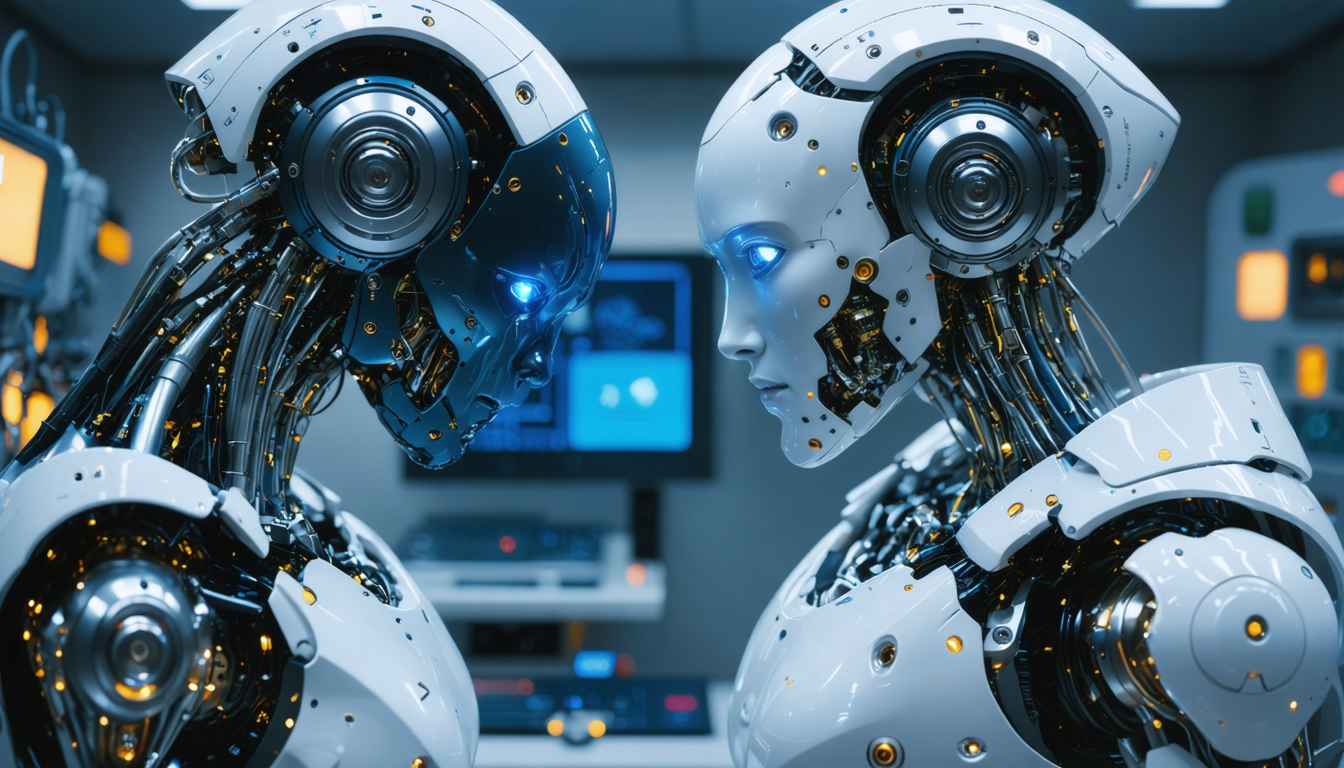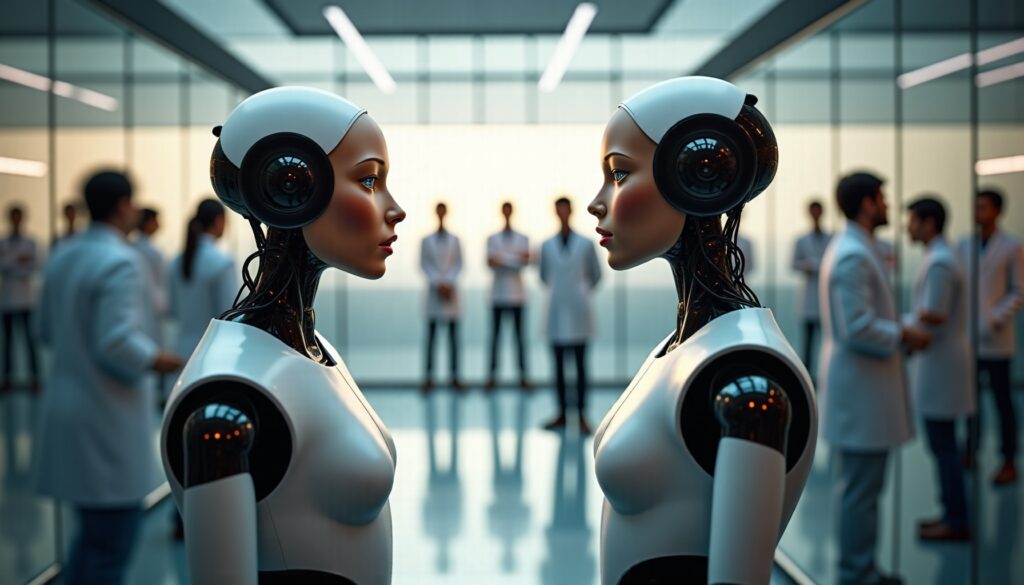
At the 2026 Consumer Electronics Show (CES), a remarkable moment marked the history of robotics and artificial intelligence: the very first free conversation between two humanoid robots was unveiled. The event captured the attention of experts and the general public alike, showcasing a major breakthrough in the field of autonomous systems. The robots Aria and David, developed by the company Realbotix, surprised with their ability to conduct a fluid, improvised, and multilingual dialogue without any human intervention or predefined script.
These humanoids, far from the classic metallic robotic models, embody a new era in technological innovation. Their conversation reflects real progress in automated communication and human-machine interaction, thanks to the implementation of a powerful artificial intelligence operating locally, without relying on the cloud. The available video allowed for understanding the nature of this robotic interaction, where each response seems to emerge from autonomous reasoning, sometimes hesitant, but surprisingly human in its expression.
- 1 Humanoid robots: a new step in conversational AI development
- 2 Detailed analysis of the first free conversation between two humanoid robots
- 3 Visual and emotional perception: a major asset for human-machine interaction
- 4 Why freeform dialogue between humanoid robots is a game changer in robotics
- 5 Current limitations of conversations between humanoid robots and their implications
- 6 The place of multilingual humanoid robots in a globalized world
- 7 The future of interaction between humanoid robots and humans: perspectives and challenges
Humanoid robots: a new step in conversational AI development
The public demonstration of Aria and David reveals how far robotics has adapted to the contemporary demands of artificial intelligence. Traditionally, humanoid robots were limited to programmed actions or guided by predefined scripts mainly serving entertainment or simple mechanical tasks. In 2026, this approach evolves to embrace genuine automated communication, where machines can think and respond in real time.
Aria and David present an unprecedented capability: engaging in dialogue without external supervision. This total autonomy is made possible by local data processing, avoiding latency and privacy issues related to the cloud. Each robot uses its own embedded AI system, whose natural language understanding algorithms and facial emotion recognition provide a more natural interaction.
This progress marks a turning point in how humanoid robots can integrate into society. Far from being mere tools, these robots become genuine interlocutors capable of adapting to the nuances of human dialogue. The advanced technology implemented by Realbotix opens up prospects in many fields:
- Customer service: robots capable of understanding customers’ needs and emotions to personalize the experience.
- Entertainment: robotic companions that improvise dialogues and strengthen social interaction.
- Research and education: interactive tools to simulate learning environments.
- Health and assistance: empathetic robots capable of detecting emotions and adapting their behavior.
The table below summarizes the main capabilities that distinguish Aria and David from previous generations of humanoid robots:
| Criterion | Humanoid Robots 2020 | Aria and David (2026) |
|---|---|---|
| Conversational autonomy | Scripted, limited | Free, improvised dialogue |
| AI processing | Cloud-dependent | Locally embedded |
| Multilingualism | Often limited | Multilingual (French, English, German, Spanish) |
| Emotional capacity | Basic | Advanced recognition of facial and vocal emotions |
Detailed analysis of the first free conversation between two humanoid robots
The widely commented video shows Aria and David exchanging not only words but also adapting to tone, rhythm, and even the chosen language during the conversation. This interaction highlights a major breakthrough in conversational artificial intelligence.
Unlike classic scripted demonstrations, Aria and David improvise at every moment. For example, when one humorously mentions an expression about the “silicon charisma,” one can sense a genuine algorithmic creative process rather than a simple prerecorded phrase. The linguistic diversity used — French, Spanish, and German — highlights the flexibility and power of the language model developed by Realbotix.
This type of spontaneous conversation is made possible by several technical innovations:
- Embedded AI: all natural language comprehension, generation, and emotional reactions are calculated on the robot, offering increased fluidity without internet dependency.
- Mutual perception: robots detect and analyze facial and vocal expressions of their interlocutor to adjust their responses.
- Use of multilingual models: capable of switching instantly from one language to another without breaking the dialogue.
- Management of hesitations and pauses: these are not flaws but create realism and credibility in the interaction.
However, despite these advances, the conversation is not yet perfectly fluent. The pauses and inconsistencies reflect the current limits of the technology. The performance of Aria and David remains an evolving challenge that will lay the groundwork for future improvements.
Video of the first conversation: immersion in technological innovation
Visual and emotional perception: a major asset for human-machine interaction
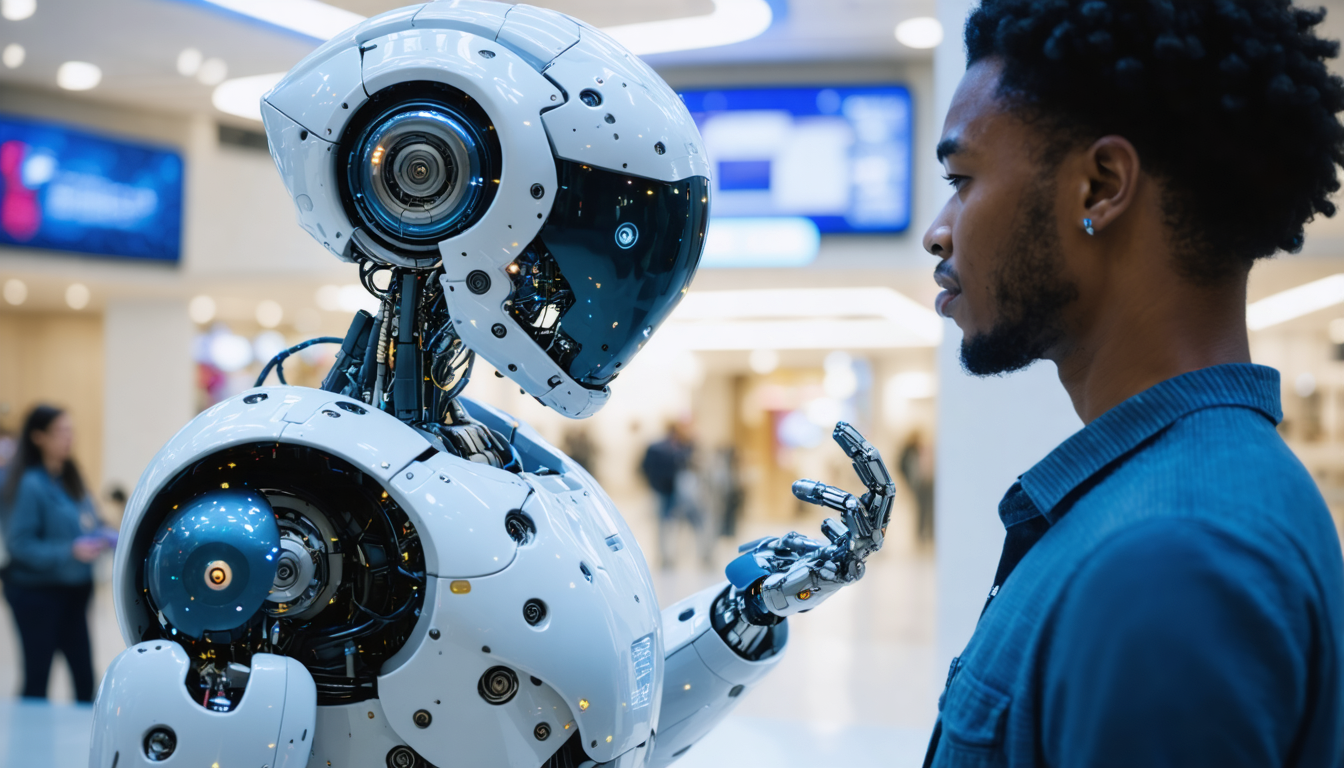
Beyond speech, Realbotix has integrated revolutionary vision technology combined with emotional analysis into its robots. This patented system allows humanoids to observe their interlocutors not only through gaze but also through fine reading of facial expressions and voice tone.
This real-time perception capacity enables robots to spontaneously adapt their speech and gestures to human reactions, thus creating a more immersive and credible experience. More than a simple verbal exchange, it is a genuine embodied social interaction.
For example, if one of the robots notices a sign of annoyance or confusion in its human or robotic partner, it can modulate its speech to restore dialogue on a more harmonious basis. This situational intelligence is essential for automated communication to be considered relevant and natural.
Applications envisioned for this technology are diverse:
- Reception robots in public spaces, capable of detecting visitors’ moods.
- Assistance companions in medical settings to better understand patients’ emotional needs.
- Educational environments where adaptability to students’ reactions improves personalized learning.
- Technical support with interpretation of non-verbal cues to anticipate customer frustrations.
Why freeform dialogue between humanoid robots is a game changer in robotics
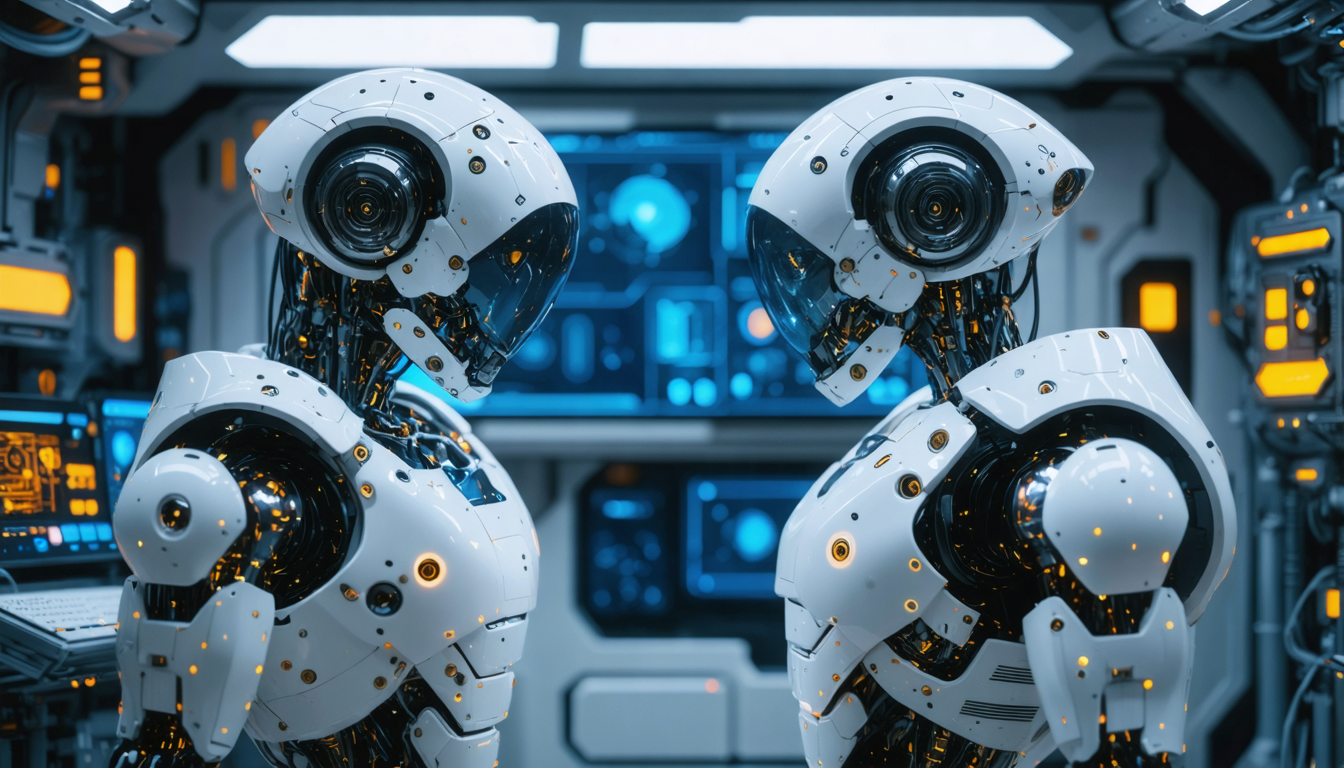
The conversation between Aria and David is not simply a robotic feat: it lays the foundation for a revolution in how robots integrate into everyday life. Previous robots could only interact by following pre-established rules, which limited their usefulness in complex and changing contexts.
The successful integration of improvised robotic conversation opens the door to truly natural dialogue, where machines understand and respond to expectations without human intervention. This potentially revolutionizes customer service, companionship, and even professional relationships involving automated systems.
This change comes with many challenges related to AI development, including the need to constantly improve fluidity, relevance of exchanges, and emotion management. Awkward pauses and still perceptible mechanics in current dialogues show that the technology is maturing, but the direction is clearly set.
At the heart of this technological innovation, robots become social partners, akin to genuine human interlocutors. They can engage in longer conversations, adjust their speech to their interlocutor, and even show humor or empathy, thus enhancing the quality of their interactions.
Concrete examples of applications for robots with improvised dialogue
- Automated kiosks with personalized assistance: smooth customer support with emotional understanding.
- Companion robots for elderly people: dialogues adapted to emotions to fight loneliness.
- Reception and orientation at public events: flexible communication facing various interlocutors.
- Interactive entertainment: creating improvised stories and spontaneous reactions depending on the audience.
Current limitations of conversations between humanoid robots and their implications
Despite the remarkable advances demonstrated by Realbotix, several technical constraints persist, impacting the quality and fluidity of exchanges between humanoid robots. The artificial intelligence hosted in these machines is powerful but not yet fully perfected.
Among the identified difficulties are:
- Dialogue synchronization: hesitations and sometimes long silences disrupt continuity and can cause loss of attention.
- Syntax or semantic inconsistencies: responses that seem off-topic or out of context reveal limits in deep understanding.
- Lack of bodily fluidity: robot movements remain mechanical, reducing the impression of naturalness.
- Emotion expression still limited: compared to robots like Ameca, Aria and David’s faces sometimes lack nuances.
These constraints highlight the complexity of the challenge represented by the revolution in human-machine interaction. Nevertheless, they do not call into question the immense potential of the advanced technology deployed, which establishes a new standard for future generations of robots.
Planned evolution and technological improvement paths
Developers are actively working on various improvement axes to reach a level of robotic communication worthy of a human interlocutor. Among the priorities are:
- Optimization of natural language algorithms to reduce inconsistencies and enrich contextual vocabulary.
- Refinement of audio-visual synchronization to harmonize movements and intonations.
- Enhancement of emotional capabilities to offer a more varied and credible palette of reactions.
- Reduction of latency times thanks to even more powerful processors and more efficient AI architectures.
The place of multilingual humanoid robots in a globalized world
The exchanges between Aria and David in several languages demonstrate the importance of linguistic flexibility in modern robotics. In a globalized economic and social context, the ability to easily switch between various languages is a major strategic asset.
This multilingual skill relies on a sophisticated language model capable of understanding, analyzing, and generating content in several idioms without breaking fluidity. This corresponds to a complex technological challenge, as each language has its own nuances, grammar, and idiomatic expressions.
Several sectors will benefit from this innovation:
- International tourism and hospitality: robots capable of welcoming and serving customers from around the world without language barriers.
- Multilingual public services: support for users in their native language, thus improving inclusivity.
- Education and training: offering interactive courses and tutoring adapted to different languages.
- International commerce: robotic assistance during multicultural negotiations or presentations.
This capability undeniably reinforces the added value of humanoid robots in worldwide automated communication.
The future of interaction between humanoid robots and humans: perspectives and challenges
The emergence of free conversations between humanoid robots initiates a profound transformation in the relationship between humans and machines. This advance invites rethinking the roles that robotics can play in society, whether as companion, personal assistant, or autonomous agent.
More than ever, advanced technology creates bridges between mechanical intelligence and emotional intelligence, opening the way to enriched human-machine interaction. Several major developments can be anticipated:
- Cognitive hybridization: coexistence of algorithmic reasoning and emotional sensitivity in robots.
- Advanced personalization: robots that adapt individually to users’ habits, personalities, and needs.
- Growing autonomy: machines capable of initiatives in social and professional exchanges.
- Ethics and regulation: the need to frame development to guarantee transparency and respect for privacy.
The challenges go beyond mere technical performance to touch the very nature of social bonds. It will be about building a harmonious coexistence based on trust and mutual understanding.